
Quick Facts
- Category
- Nage-Waza
- Subcategory
- Ashi-Waza
- Difficulty
- Advanced
- Belt Level
- 1st kyu, 1st dan
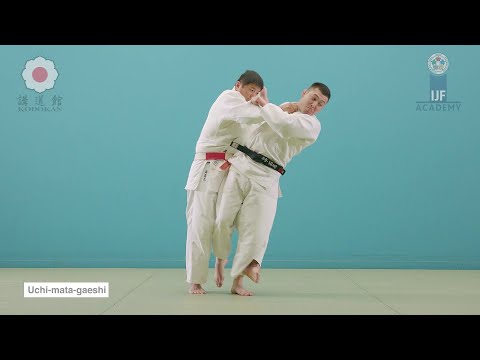
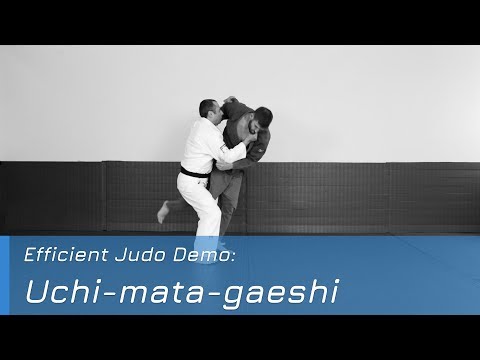
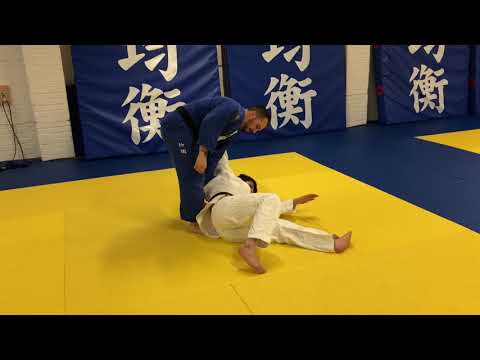
Uchi-Mata-Gaeshi is the catching counter to Uchi-Mata. As uke penetrates between tori's legs with the sweeping leg, tori actively catches uke's sweeping leg by clamping their thighs together, immobilizing it. With uke now trapped in this committed position, tori steps forward and drives uke downward to the mat — forward or laterally. This technique should not be confused with Uchi-Mata-Sukashi, which counters by avoiding (slipping) the sweep. Uchi-Mata-Gaeshi counters by catching and using uke's committed sweeping leg as the mechanism of defeat. Part of the Kodokan Shinmeisho no Waza.
Uchi-Mata-Gaeshi — Step by Step
Kuzushi comes from uke's absolute commitment to the Uchi-Mata penetration. When uke drives their sweeping leg between tori's legs and rotates their hip across, they are entirely single-legged and committed to the throw direction. By catching the leg and stepping forward, tori redirects this committed force downward, creating a forward off-balance that uke cannot recover from.
As uke's sweeping leg rises between your thighs, clamp both thighs together to trap it. Simultaneously drop your own center of gravity slightly, sinking your hips to lower your base. Your grips stabilize uke's upper body to prevent them from adjusting or releasing.
With uke's sweeping leg trapped, step or drive your base forward toward uke's supporting foot. Press your body weight forward and downward through uke's trapped position, forcing uke to fall forward or to the side. The trapped leg prevents uke from stepping away to recover.
- 1
Read uke's Uchi-Mata penetration
Detect the hip rotation and inner thigh drive that characterize Uchi-Mata entry. The moment uke's leg begins to rise between your thighs, the catching counter window opens.
- 2
Clamp your thighs to catch and trap uke's sweeping leg
As uke's leg rises, actively squeeze both thighs together to trap uke's sweeping leg between them. The clamp must be firm — this is the core mechanic that immobilizes uke's attack.
- 3
Sink your hips slightly to lower your center
Drop your center of gravity slightly as you clamp, stabilizing your own base. This also makes the clamp more secure by lowering your thigh contact point.
- 4
Step forward to drive your weight into uke
Step forward toward uke's supporting foot or step diagonally. Drive your body weight forward through uke's upper body, loading uke's balance forward and downward.
- 5
Direct uke down to the mat
Continue pressing forward, using grip control to guide uke's fall — either directly forward or diagonally to the side. Uke's trapped leg prevents them from stepping out or recovering.
What Makes It Work
- The distinction from Uchi-Mata-Sukashi is fundamental: Sukashi avoids the sweep (the leg slips through); Gaeshi catches it (the leg is clamped and held). Both counter Uchi-Mata but through opposite mechanisms.
- The thigh clamp must be active and deliberate — not just closing legs together but actively squeezing to trap.
- Once the leg is caught, uke is committed and immobile. The finish requires only forward pressure, not further technical complexity.
- Speed of the catch is critical — if uke's leg rises too high before being clamped, the opportunity window narrows rapidly.
- Grip control of uke's upper body during the catch prevents them from post-withdrawing the sweeping leg before the finish.
What to Avoid
Confusing with Uchi-Mata-Sukashi and stepping aside instead of catching
Uchi-Mata-Gaeshi catches and uses the leg — you clamp your thighs together. Uchi-Mata-Sukashi avoids by stepping around. Decide which counter before uke attacks and commit to the choice.
Insufficient thigh clamp — uke's leg escapes
The clamp must be firm and active. Practice the thigh squeeze independently until the muscle memory is strong.
Stepping backward instead of forward during the finish
The finish requires driving forward toward uke's supporting leg base. Stepping backward removes your forward pressure and allows uke to withdraw.
Releasing the grip on uke's upper body while clamping
Maintain grip control throughout. Losing the grip allows uke to adjust their upper body and possibly pull the sweeping leg free.
Best Moments to Apply Uchi-Mata-Gaeshi
Uchi-Mata-Gaeshi is most effective when uke drives deeply and commits heavily to Uchi-Mata. Opponents with a powerful, penetrating Uchi-Mata that rises high between the thighs are the ideal target. It can also be applied against Hane-Goshi and similar inner-leg raises. In competition, using Uchi-Mata-Gaeshi alongside Uchi-Mata-Sukashi as alternating counters creates unpredictability — uke cannot know whether their Uchi-Mata will be avoided or caught.