Quick Facts
- Category
- Nage-Waza
- Subcategory
- Ashi-Waza
- Difficulty
- Advanced
- Belt Level
- 2nd kyu, 1st kyu
Uchi-Mata is the most frequently scored technique in elite judo competition and widely regarded as one of the most powerful and versatile throws in judo. Tori enters from a forward-angled pivot and sweeps their leg upward between uke's legs, contacting the inner thigh to propel them forward and over. It can be executed from multiple grips, both sides, and both standing and drop entries.
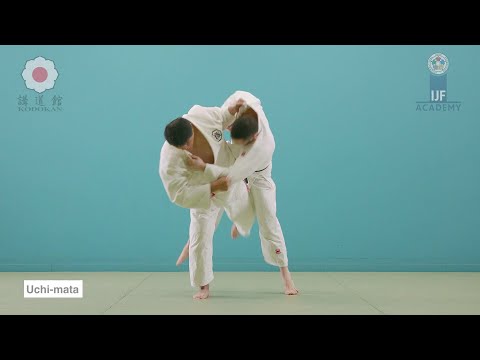
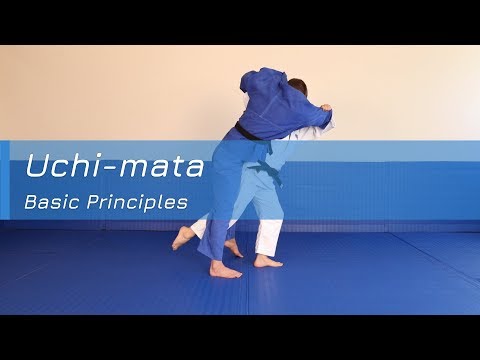
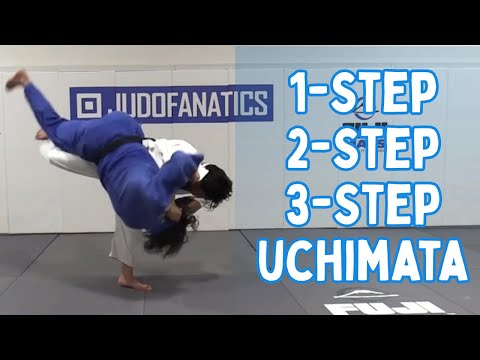


Uchi-Mata — Step by Step
Pull uke forward and to their right front corner. Your sleeve hand pulls uke's elbow across your centerline and slightly upward. Your lapel hand drives forward and upward. Uke must be leaning forward with weight transferring to the balls of their feet.
Step your right foot in front of uke at a slight angle, then pivot so your back faces uke at roughly 45 degrees. Unlike a full hip turn, Uchi-Mata uses a forward-angled position. Your left foot lands to give you a base, but the key is driving your right leg forward and up.
Drive your right leg forward and then sweep it powerfully upward between uke's legs, contacting the inner thigh of uke's right leg with the inner surface of your right thigh/hamstring. Simultaneously pull forward and rotate to project uke over your hip in a forward arc. The sweeping leg drives uke's legs upward while your arms project their upper body forward.
- 1
Break uke's balance to their right front corner
Pull the sleeve arm across your centerline and up. Drive the lapel arm forward. Uke's weight must be forward before entry.
- 2
Step in at a 45-degree angle
Step your right foot in front of uke but at a 45-degree angle — not a full hip turn. Your body faces forward-diagonally, not completely back-to-uke.
- 3
Pivot and load on your left leg
Pivot on your right foot, bringing your left foot to establish a one-legged base. Your weight loads onto your left leg — all sweeping power comes from this leg position.
- 4
Drive right leg forward and sweep upward
Swing your right leg forward (pendulum motion) and then drive it powerfully upward between uke's legs. Contact the inner surface of your right thigh against the inside of uke's thigh.
- 5
Project uke forward over your hip
Pull forward strongly with both hands while the leg sweep elevates uke's legs. Uke is projected forward in a high arc. Maintain grip for follow-through to ne-waza.
What Makes It Work
- The sweep is between uke's legs, contacting the inner thigh — not a hip throw hitting the outer thigh.
- The forward-angled pivot distinguishes Uchi-Mata from hip throws: you are not fully back-to-uke.
- The leg sweep drives upward with force — the higher you can elevate uke's leg, the more complete the throw.
- Uchi-Mata can be done from multiple grip configurations: standard sleeve-lapel, belt, or over-the-back grips all work.
- Both sides of Uchi-Mata should be trained — switching from right to left is a high-level competition tactic.
What to Avoid
Pivoting too fully — body turned too far like a hip throw
Uchi-Mata uses a partial turn. Over-rotating means your leg cannot penetrate between uke's legs effectively.
Sweeping at the knee instead of the inner thigh
Drive the leg deep between uke's legs. Contact at the knee is less effective and can be illegal in competition.
Not committing the whole body to the forward projection
The throw requires your entire body moving forward and down — not just the leg. Pull with both hands strongly during kake.
Insufficient kuzushi — entering against an upright, grounded uke
Uchi-Mata against a stable uke results in a blocked, dangerous position. Never enter without prior kuzushi.
Best Moments to Apply Uchi-Mata
Uchi-Mata is effective against all body types but particularly against same-height or taller opponents — the inner thigh target is easier to reach. It works best when uke is in a rounded or defensive posture (more inner thigh exposed). Classic combinations: Harai-Goshi → Uchi-Mata (switch outer to inner), Ko-Uchi-Gari → Uchi-Mata, Osoto-Gari → Uchi-Mata. Both standing and drop (drop knee to mat) entries should be trained — drop Uchi-Mata is heavily used in elite competition.