Quick Facts
- Category
- Nage-Waza
- Subcategory
- Ashi-Waza
- Difficulty
- Advanced
- Belt Level
- 2nd kyu, 1st kyu
Tsubame-Gaeshi (Swallow Counter) is a counter-throw specifically designed to defeat De-Ashi-Barai. When tori attempts De-Ashi-Barai against uke's advancing foot, uke lifts the targeted foot up and over tori's sweeping leg in a rapid swallow-like arc, then immediately sweeps tori's own standing (base) foot in the same flowing motion. The name evokes the swift, curved flight of a swallow in flight. It is part of the Kodokan Shinmeisho no Waza and represents one of the most elegant counter-sweep sequences in judo.
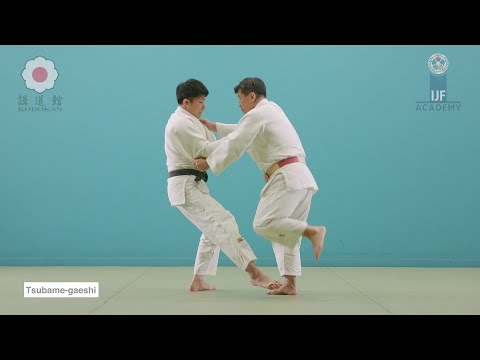
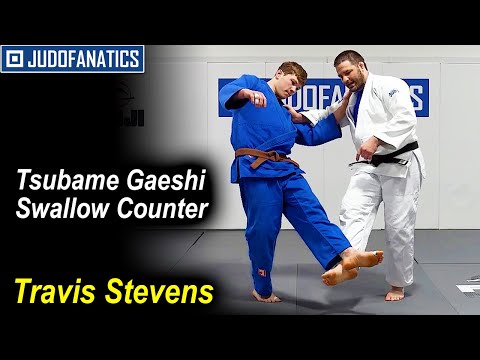
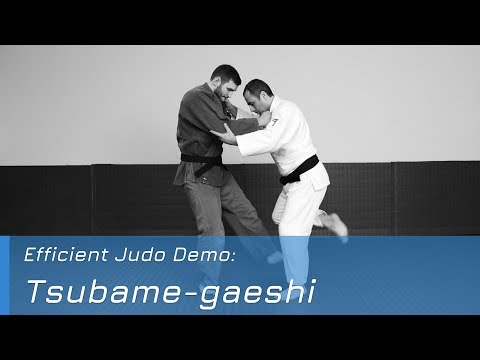

Tsubame-Gaeshi — Step by Step
Kuzushi is derived entirely from uke's commitment to the original De-Ashi-Barai sweep. As tori sweeps and shifts their body weight to the sweeping side, their remaining base foot becomes the vulnerable target. Uke's evasion leaves tori momentarily overextended and single-legged — an ideal condition to sweep the standing foot backward.
As tori's sweeping foot approaches, lift the targeted foot rapidly upward and across tori's sweeping leg. Your weight shifts fully to the opposite (standing) foot as you arc over. Immediately redirect your lifted foot downward in a sweeping path toward tori's base ankle. The transition from evasion to sweep is continuous — there is no pause.
Sweep tori's standing ankle or foot with the sole of your foot in a lateral or backward-lateral arc, mirroring the mechanics of De-Ashi-Barai itself. Simultaneously pull tori's arms (or release your grips to redirect momentum) to amplify the toppling force. The sweep removes tori's only ground contact at the precise moment their weight is fully committed to it.
- 1
Detect the incoming De-Ashi-Barai
Read tori's grip tension and body positioning. A De-Ashi-Barai attempt is typically preceded by a pull on the sleeve grip as tori loads for the sweep. Visual and tactile cues give a fraction-of-a-second warning.
- 2
Lift the targeted foot up and over the sweep
As tori's sweeping foot arrives, rapidly elevate your targeted foot, arcing it upward and over tori's sweeping leg in a smooth curve. The motion should be swift and continuous — think of a swallow banking in flight.
- 3
Land your weight on the opposite (base) foot
As your lifted foot crosses over tori's sweep, all your weight momentarily rests on the opposite foot. This is also the foot you will sweep from, so the transition must be immediate.
- 4
Redirect into the counter sweep
Without pausing, redirect the arcing foot downward into a sweep toward tori's now-loaded base ankle. The path from evasion into sweep is a single arc — the foot goes up and over, then comes down and sweeps.
- 5
Coordinate the arm pull to complete the throw
Pull tori's arms (sleeve and lapel) in the direction of the sweep to unbalance their upper body in concert with the foot sweep. Tori's weight is committed to the sweep side — the arm pull and counter sweep combine to topple them.
What Makes It Work
- The counter must flow as one continuous motion — foot lifts, arcs over, and sweeps in a single swallow-like curve. Any hesitation between evasion and sweep allows tori to recover.
- Timing the evasion requires reading tori's intentions before the sweep arrives. Reacting to the sweep after contact is too late.
- Your own counter sweep uses the same mechanics as De-Ashi-Barai — sole of foot, lateral sweep, at peak weight transfer. The principles that make De-Ashi-Barai effective apply equally here.
- This technique demonstrates a fundamental judo principle: an attacker who over-commits to a technique creates the opening for their opponent to counter.
- The swallow imagery is instructional — think of the light, curved, decisive motion of a bird in flight, not a heavy kick.
What to Avoid
Lifting the foot too slowly — swept before evading
The evasion must be triggered at the first signal of the incoming sweep, not after contact. Train the foot-lift as a rapid reflex response to the grip tension that precedes De-Ashi-Barai.
Pausing between evasion and counter sweep
The arc over and the counter sweep are one motion. Practice the combined sequence as a single fluid action until the pause disappears.
Sweeping the wrong foot — sweeping toward tori's sweeping side instead of the base
Target tori's base foot — the foot they are standing on while they sweep. The sweeping foot is already mobile and carries no weight.
No arm control — counter sweep has no upper-body amplification
Coordinate arm pull with the sweep. The foot sweep alone may not be sufficient; the arm direction collapses tori's upper body in concert.
Best Moments to Apply Tsubame-Gaeshi
Tsubame-Gaeshi is the dedicated counter to De-Ashi-Barai and is most effective when an opponent repeatedly attacks with foot sweeps. It can also be applied against Okuri-Ashi-Barai and similar lateral foot sweeps where one foot is lifted and the other is loaded. Competitors who drill this counter shift the dynamic of any foot-sweep heavy game entirely.