
Quick Facts
- Category
- Nage-Waza
- Subcategory
- Ashi-Waza
- Difficulty
- Advanced
- Belt Level
- 2nd kyu, 1st kyu
Osoto-Gaeshi is the counter-throw to O-Soto-Gari. When uke attempts O-Soto-Gari by driving their leg behind tori's and reaping, tori shifts their body weight onto the threatened (reaping-side) leg, steps around uke's committed attack, and applies their own O-Soto-Gari to uke's now-extended and weight-committed supporting leg. The principle is to absorb and redirect the attack force rather than resist it. Part of the Kodokan Shinmeisho no Waza, it exemplifies the judo concept of ju (yielding) applied to ashi-waza.
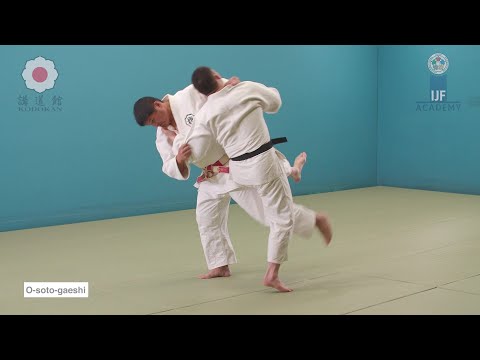
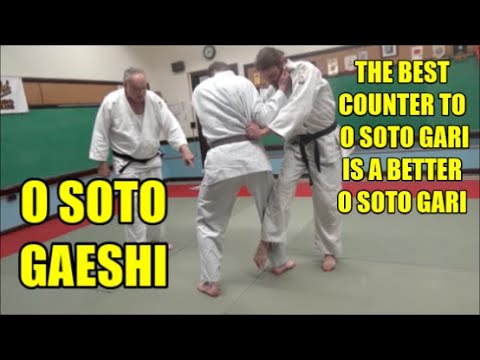
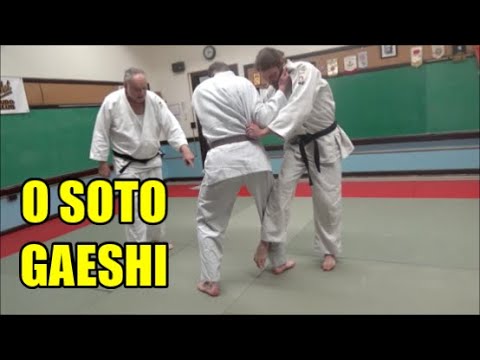
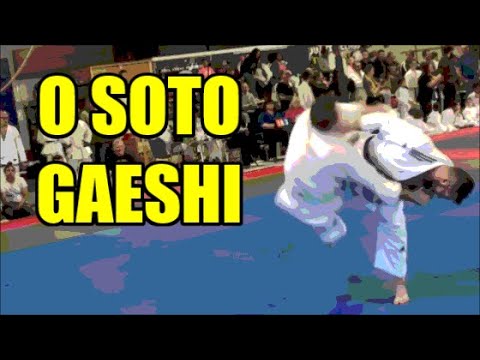
Osoto-Gaeshi — Step by Step
Kuzushi comes from uke's own commitment to the O-Soto-Gari attack. As uke drives their leg behind tori and leans into the reap, their body weight shifts heavily to the supporting leg — which becomes unguarded. The moment of maximum attack commitment is simultaneously the moment of maximum counter-throw opportunity.
As uke's reaping leg sweeps behind and uke leans forward into the throw, shift your weight onto the leg being targeted (rather than away from it). Step or pivot your body around and slightly behind uke, positioning your reaping leg to attack uke's committed supporting leg. Maintain your upright posture — do not collapse away from the attack.
Sweep or reap uke's supporting leg from the outside with your own leg (using O-Soto-Gari mechanics) while pulling uke's upper body forward or downward with your grips. Uke's weight is already committed to the supporting leg — your reap removes it. Direct uke's fall backward or to the side.
- 1
Read and absorb uke's O-Soto-Gari attack
As uke drives into the O-Soto-Gari, resist the instinct to step away from their reaping leg. Instead, remain upright and shift weight toward the uke's attacking side. Stepping away allows the reap to complete; absorbing it sets up the counter.
- 2
Shift weight onto the targeted leg
Transfer your body weight onto the leg uke is attempting to reap. This requires accepting that uke's leg is sweeping behind you while you remain stable on that leg.
- 3
Step or pivot around to uke's outside
Pivot or step your free leg around and behind uke to bring yourself to the outside of uke's supporting leg. Your body now positions for the counter-reap.
- 4
Drive your reaping leg into uke's supporting leg
Apply O-Soto-Gari mechanics to uke's now-exposed supporting leg — sweep from the outside and behind, with your reaping leg swinging through in a large arc.
- 5
Pull uke's upper body to complete the throw
Use your grips to pull uke's torso forward or diagonally downward as you reap, amplifying the destabilization created by removing their base leg. Uke falls backward.
What Makes It Work
- The counter requires accepting the attack rather than fleeing from it. Stepping away from the reap validates the attack; stepping toward it sets up the counter.
- Uke's moment of maximum commitment — both legs positioned for the reap — is the moment their support leg is most vulnerable.
- The mechanics of the counter throw are identical to the original O-Soto-Gari — large outer reap, arm pull, body drive.
- Speed of recognition is critical. The transition from absorbing the attack to launching the counter must be rapid enough that uke cannot retreat.
- Body position during the counter must be upright — collapsing away from the attack removes the ability to counter.
What to Avoid
Stepping away from uke's reaping leg
Move toward the attack, not away. Retreating allows the O-Soto-Gari to succeed. Shift weight onto the targeted leg instead.
Counter-throwing too late — uke has already recovered
The window for the counter is the instant uke is fully committed. A half-second delay allows uke to pull their reaping leg back and reset.
Losing upright posture when absorbing the attack
Maintain height and posture. Bending forward when uke attacks makes the counter reap from a mechanically weak position.
Using arm strength alone without the full reap
The counter must include the leg sweep component. Pulling uke's arms without reaping their base leg is unlikely to complete the throw.
Best Moments to Apply Osoto-Gaeshi
Osoto-Gaeshi is most effective against opponents who commit heavily to O-Soto-Gari with a full body lean. The heavier uke's commitment, the more force is available for the counter. It is also applicable against O-Soto-Otoshi variations. In competition, drilling Osoto-Gaeshi as the automatic response to any O-Soto-Gari attack changes the risk calculus for opponents who rely on the technique.