
Quick Facts
- Category
- Nage-Waza
- Subcategory
- Ashi-Waza
- Difficulty
- Intermediate
- Belt Level
- 4th kyu, 3rd kyu, 2nd kyu
Okuri-Ashi-Barai is a sweeping foot technique executed against both of uke's feet simultaneously as they move laterally. Tori times the sweep to catch uke mid-step when both feet are momentarily close together — the "following foot" (the trailing foot moving to catch up) is swept to collide with or sweep the lead foot, taking both feet out and dropping uke laterally. It is considered one of the most elegant and timing-sensitive techniques in judo.
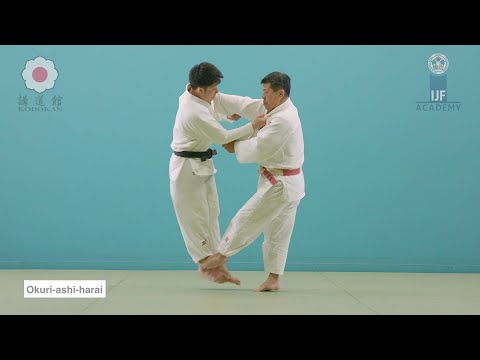

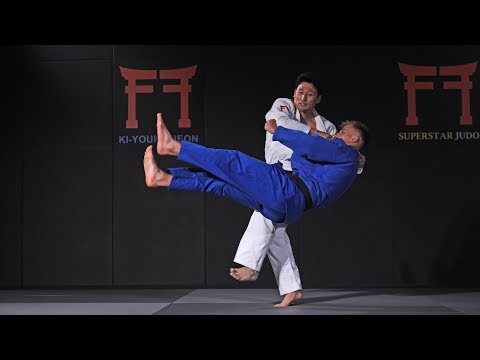

Okuri-Ashi-Barai — Step by Step
Move uke laterally by pushing and pulling them to one side. As uke takes a lateral step, their lead foot lands and their trailing foot follows — at the moment the trailing foot is closing the gap, uke's weight is briefly distributed between both feet. This is the kuzushi moment: uke is neither fully on one foot nor the other.
Move with uke to create the stepping pattern. As uke steps to their right, their right foot plants and their left foot begins to follow. Time your sweep to coincide with the moment the left foot is closing toward the right. Position your sweeping right foot with a flat, horizontal arc ready to contact the back of uke's ankle region.
Sweep your right foot in a flat, horizontal arc (like sweeping a floor) to contact the back of uke's left ankle as it moves toward the right foot. The sweep pushes uke's left foot into their right foot, sweeping both from under them. Simultaneously pull the sleeve arm downward and push the lapel arm upward to topple uke to their right side.
- 1
Establish lateral motion with uke
Move uke side-to-side using arm pressure and body movement. You need a rhythmic, predictable stepping pattern to time the sweep.
- 2
Identify the "following foot" moment
Watch for uke's trailing foot closing toward the lead foot. This brief window — when both feet are close together — is the target.
- 3
Swing the sweeping foot into position
As uke's trailing foot nears the lead foot, raise your sweeping foot and bring it in a wide, flat horizontal arc toward uke's ankle level.
- 4
Execute the ankle-level sweep
Contact the back of uke's trailing ankle with a brushing, sweeping motion — flat and parallel to the ground. Push the foot toward uke's other foot.
- 5
Complete with coordinated arm action
As the sweep makes contact, pull the sleeve arm downward and toward you while lifting and pushing the lapel arm upward. Uke drops laterally to the mat.
What Makes It Work
- Timing is the entire technique — sweeping a planted, loaded foot is ineffective. Contact must happen when the foot is moving.
- The sweep is flat and horizontal — like brushing a floor, not lifting a leg. Lifting results in a blocked, upward-deflecting foot.
- Lateral motion must be pre-established; you cannot create the following-foot moment from a stationary position.
- Arm action (sleeve pull, lapel push) directs uke's fall and must coordinate precisely with the sweep.
What to Avoid
Sweeping too early — catching the planted foot
Wait for the following foot to be in motion before sweeping. Sweeping a planted foot meets resistance and fails.
Sweeping with a lifting motion instead of a flat arc
The sweep should be parallel to the ground, like brushing a floor. Lifting the foot causes it to glance off uke's ankle without removing it.
No coordinated arm action
The sweep alone will not drop uke — the sleeve pull and lapel push must direct uke's fall. Arm and leg must act together.
Moving too slowly or hesitating
Okuri-Ashi-Barai requires commitment. Half-speed sweeps alert uke and give them time to adjust their footing.
Best Moments to Apply Okuri-Ashi-Barai
Okuri-Ashi-Barai is most effective when uke is moving laterally in a predictable pattern — common during circular movement (tai-sabaki) or when moving around the mat edge. It is excellent against opponents who take large lateral steps and is a staple in high-level competition as a set-up technique from circular movement.