Quick Facts
- Category
- Nage-Waza
- Subcategory
- Ashi-Waza
- Difficulty
- Beginner
- Belt Level
- 6th kyu, 5th kyu
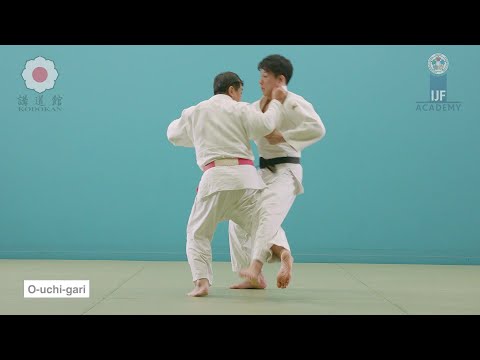
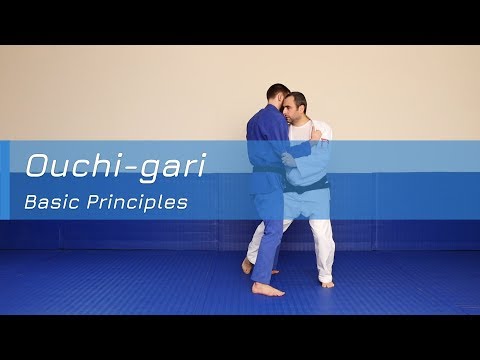
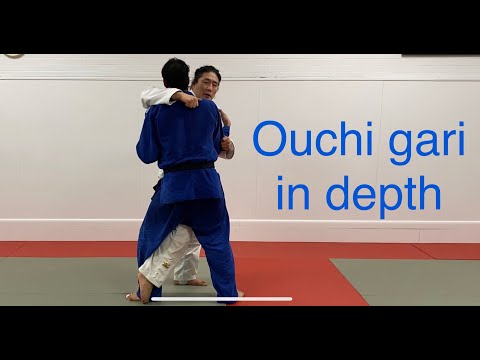
O-Uchi-Gari is a major inner leg reap — one of the foundational judo throws and a fixture in high-level competition. Tori drives uke backward and off-balance, then sweeps the inside of uke's leg with a hooking reap. It pairs naturally with Osoto-Gari to form one of judo's most effective combination attacks.

O-Uchi-Gari — Step by Step
Drive uke backward and to their right rear corner. Your lapel hand pushes uke's chest upward and backward. Your sleeve hand pulls upward. Uke's weight must be on their right heel before you attack.
Step your right foot inside uke's stance, roughly level with their right foot, positioning yourself to attack from an inside angle.
Swing your left leg in a hooking arc, driving the inner surface of your left calf into the back of uke's right calf/ankle area. Simultaneously, lean your upper body forward over uke and drive your lapel hand backward into their chest. The inner reap sweeps uke's right foot forward while your body pushes them backward.
- 1
Push uke backward to their right rear corner (kuzushi)
Drive your lapel hand into uke's chest and push them backward. Your sleeve arm pulls upward. Uke's weight shifts to their right heel.
- 2
Step in with your right foot
Plant your right foot to the inside-left of uke's right foot. You are now positioned between or beside uke's legs.
- 3
Swing your left leg into the reap
Hook your left leg behind uke's right leg, making contact with the inner surface of your left calf against the back of uke's calf/ankle. The action is a hooking reap, scooping uke's foot upward and forward.
- 4
Drive your upper body forward over uke
Lean your chest forward over uke as you reap. Your body weight drives them backward while the reap sweeps their leg forward — a scissoring action that is difficult to resist.
- 5
Follow through and drive to the mat
Carry through the reap and body drive until uke is fully on the mat. Maintain grip control throughout for potential transition to ne-waza.
What Makes It Work
- The inner reap scoops uke's foot forward while the upper body drives them backward — this scissoring action is the core of the technique.
- Backward kuzushi is mandatory. Inner reap against an upright uke is easily blocked — they just pick up the attacked leg.
- The reaping leg hooks around the ankle/calf area, not the thigh. Contact too high allows uke to step over.
- O-Uchi-Gari pairs naturally with Osoto-Gari: if uke defends one side (inner), switch to the other side (outer), and vice versa.
What to Avoid
Attacking an upright uke with no backward kuzushi
Push them backward first. Without prior kuzushi, uke simply picks their leg up and you are off-balance.
Not driving the upper body over uke during kake
Lean forward over uke while reaping. The scissoring action requires the body drive; the leg alone is not enough.
Too narrow an entry — stepping between uke's feet and losing base
Step your base foot to a slight angle — your entry foot should be beside uke's right foot, not crossing past it. Drill the entry position until your weight naturally stays on the correct side.
Reaping at the thigh (too high)
Target the calf or ankle. High contact is easily blocked — uke simply straightens their leg over your reap.
Best Moments to Apply O-Uchi-Gari
O-Uchi-Gari is devastating as part of a combination with Osoto-Gari. Attack Osoto-Gari from the outside — if uke defends by shifting weight inward, immediately switch to O-Uchi-Gari on the opposite leg. Also effective when uke is stepping forward with their right leg (catching it mid-step when weight is transferring onto it).
Counters to O-Uchi-Gari
Combination Sequences
Follow up with