Quick Facts
- Category
- Nage-Waza
- Subcategory
- Ashi-Waza
- Difficulty
- Advanced
- Belt Level
- 2nd kyu, 1st kyu
O-Uchi-Gaeshi is the counter-throw to O-Uchi-Gari. When uke hooks inward with their leg to perform O-Uchi-Gari, tori pivots outward away from the hooking leg — turning uke's inside attack into an outside exposure — and applies Ko-Soto-Gari or O-Soto-Gari to uke's now-extended supporting leg. The counter converts uke's inward leg attack into an outward leg attack on the vulnerable support. Part of the Kodokan Shinmeisho no Waza.
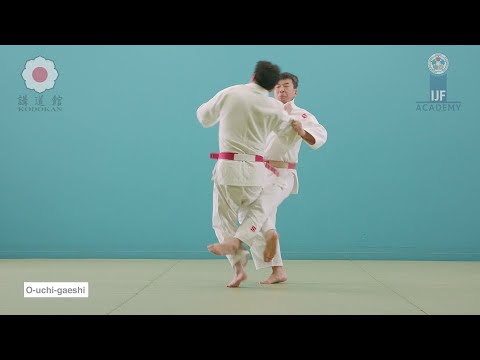
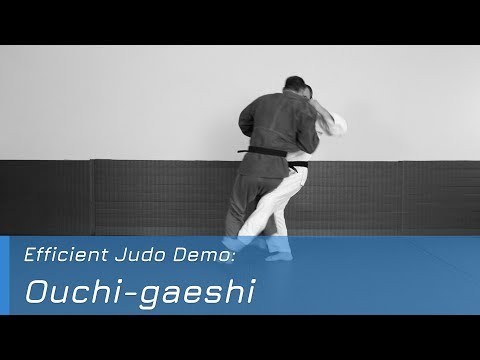
O-Uchi-Gaeshi — Step by Step
Uke's commitment to the O-Uchi-Gari reap locks their weight and attention into the inward hooking motion. As their reaping leg drives inward and their body leans into the attack, their supporting leg becomes the sole base — bearing all their weight and unguarded. The pivot and counter exploit this moment of single-leg dependence.
As uke's reaping leg hooks inward between your legs (or against your inner thigh), pivot your body outward — rotating on your stable foot away from the hook direction. This rotation moves you to the outside of uke's attack and positions your reaping leg to attack uke's supporting leg from the outside.
Apply Ko-Soto-Gari or O-Soto-Gari to uke's supporting leg — sweep or reap it from the outside-rear. Simultaneously pull uke's upper body forward and downward with your grips. Uke's single supporting leg is swept away while their torso is directed downward.
- 1
Detect uke's O-Uchi-Gari hook
Feel uke's leg driving inward and their body weight shifting into the attack. The grip tension will increase on the side of the attacking leg as uke prepares to load the reap.
- 2
Pivot outward on your stable foot
As uke's leg hooks inward, pivot your body outward — rotating away from the hook. Your foot on the attacked side turns outward, moving your body to uke's outside.
- 3
Position your leg behind uke's supporting leg
The outward pivot brings you to uke's outside, where uke's supporting leg is exposed. Position your attacking leg to sweep or reap from behind or the outside.
- 4
Apply Ko-Soto-Gari or O-Soto-Gari to uke's support
Sweep uke's supporting leg outward (Ko-Soto-Gari) or reap it from behind (O-Soto-Gari). The mechanics follow the same principles as those primary techniques.
- 5
Pull uke's upper body to complete the throw
Simultaneously direct uke's torso forward or diagonally downward with your grips as you sweep. The combination of the leg sweep and upper body direction causes uke to fall.
What Makes It Work
- The pivot outward is the defining action — it converts uke's inward attack into an opportunity for an outward counter.
- Uke's supporting leg is the target, not the reaping leg. The reaping leg is mobile and bears no weight.
- The counter applies the mechanics of Ko-Soto-Gari or O-Soto-Gari — techniques that should already be well-understood.
- Speed of recognition matters: the window is the moment uke's reaping leg is committed inward and cannot quickly return.
- The upper-body pull must coordinate with the leg sweep. A leg sweep without upper-body direction is far less effective.
What to Avoid
Stepping inward (toward the hook) instead of pivoting outward
The counter requires moving to the outside. Moving inward into the hook allows O-Uchi-Gari to succeed.
Targeting uke's reaping leg instead of the supporting leg
Focus on the supporting leg — it bears all weight and is the actual target. The reaping leg is in the air and has no base.
Pivot too slow — uke withdraws the reap before the counter lands
The outward pivot must begin the instant uke's reap is detected. A slow pivot allows uke to abort the attack and reset.
No arm control during the counter sweep
Pull uke's upper body in the direction of the sweep. Leg sweep without arm coordination is partial and less reliable.
Best Moments to Apply O-Uchi-Gaeshi
O-Uchi-Gaeshi is most effective against opponents who rely heavily on O-Uchi-Gari as a primary attack. The outward pivot pairs especially well if uke overextends their hooking leg or drives too far with their body weight. It can also be applied against Ko-Uchi-Gari attempts where the inward hook mechanics are similar. In competition, establishing this counter changes uke's risk calculus for repeated inner-leg attacks.