
Quick Facts
- Category
- Nage-Waza
- Subcategory
- Ashi-Waza
- Difficulty
- Intermediate
- Belt Level
- 4th kyu, 3rd kyu, 2nd kyu
Harai-Tsurikomi-Ashi is a lifting foot sweep in which tori steps across uke's front and sweeps the near leg while simultaneously lifting uke upward with both arms. The name describes the action: "harai" (sweep/reap), "tsuri" (lift), "komi" (pull), "ashi" (foot/leg). The combined lifting pull and sweeping action removes uke's support and sends them forward to the mat. It differs from simpler foot sweeps by incorporating the distinctive upward arm lift that raises uke onto their toes before the sweep.
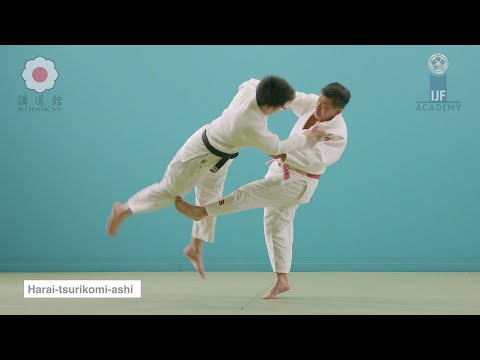
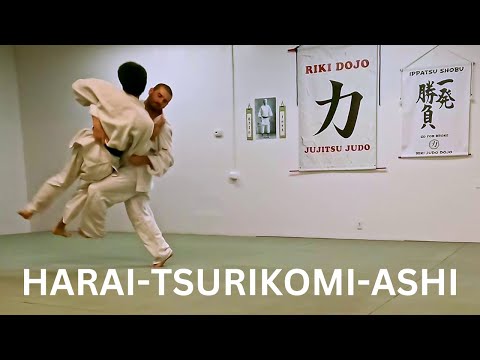


Harai-Tsurikomi-Ashi — Step by Step
Step diagonally forward and to the right, pulling uke's sleeve arm forward and upward while the lapel arm also lifts upward. The lifting action should bring uke onto their toes and forward, breaking their balance to their front. The arms act in a "tsuri" (fishing/lifting) motion — pulling upward as if lifting a fish from water.
Step your left foot across and in front of uke, positioning yourself diagonally. Your weight transfers to the left leg as you set up the sweep position. Your sweeping foot (right) prepares to arc across toward uke's right ankle or lower shin. Maintain the lifting tension on both arms.
As uke's right foot begins to shift forward under the lifting pressure, sweep your right foot in a wide, flat arc against uke's right ankle or lower shin, pushing it across and away. Simultaneously continue the upward pull with both arms, completing the lift-and-sweep combination that rotates uke forward to the mat.
- 1
Apply the lifting kuzushi
Pull uke's sleeve arm upward and forward while the lapel arm lifts as well. Draw uke forward onto their toes in a lifting "fishing" motion.
- 2
Step diagonally across uke's front
Move your left foot diagonally forward and across uke's centre line, transferring your weight to the left leg and positioning your body to the side.
- 3
Align the sweeping foot
Position your right foot to sweep from outside to inside across uke's ankle. The foot should be at ankle height, toes pointing slightly downward for a flat sweep.
- 4
Sweep and lift simultaneously
Drive the sweeping foot across uke's ankle while maintaining or increasing the upward arm lift. The sweep and lift happen together, not in sequence.
- 5
Direct uke's fall forward
Continue pulling the sleeve arm forward and down while the lapel arm guides uke's fall. Uke is projected forward and slightly to the side to the mat.
What Makes It Work
- The lifting arm action (tsuri-komi) is what distinguishes this from a standard foot sweep — both arms actively lift before and during the sweep.
- The sweep must be flat and horizontal at ankle level — a rising sweep deflects off the shin and misses.
- Uke must be on their toes (kuzushi established) before the sweep is initiated; sweeping a flat-footed uke is ineffective.
- Stepping diagonally positions your body to sweep across uke's foot rather than into it.
What to Avoid
Pulling arms forward instead of upward
The "tsuri" (lift) component means the arms pull upward. A purely forward pull creates a different kuzushi that reduces the effectiveness of the sweep.
Sweeping before kuzushi is established
Uke must be lifted onto their toes before the sweep begins. An early sweep against a flat-footed uke creates resistance.
Sweeping into uke's ankle instead of across it
The sweep travels across the front of uke's ankle from outside to inside. Sweeping directly into the ankle stubs the foot rather than removing the leg.
Stepping too close to uke before the sweep
You need room for the sweeping leg to arc. Too close and the sweep has no space to generate force.
Best Moments to Apply Harai-Tsurikomi-Ashi
Harai-Tsurikomi-Ashi works particularly well when uke is taller than tori, as the lifting arm action makes use of the height differential. It is effective when uke steps forward predictably, and is often set up by drawing uke forward with a retreat. The technique is a strong option against opponents with good balance who resist simple foot sweeps.
Variations of Harai-Tsurikomi-Ashi
Combination Sequences
Attack these first
Follow up with