
Quick Facts
- Category
- Nage-Waza
- Subcategory
- Ashi-Waza
- Difficulty
- Beginner
- Belt Level
- 6th kyu, 5th kyu
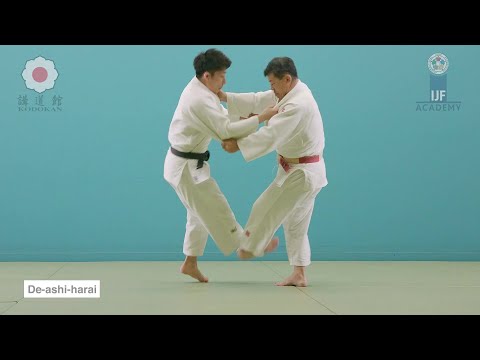
De-Ashi-Barai is a timing-based foot sweep that intercepts uke's advancing foot as it steps forward and bears weight. Unlike power throws, De-Ashi-Barai relies entirely on precise timing — the sweep catches uke's foot at the exact moment weight transfers onto it, making resistance impossible. When timed perfectly, uke is swept off their feet with minimal effort.


De-Ashi-Barai — Step by Step
Pull uke forward with your sleeve hand as their advancing foot lands, amplifying the moment of full weight transfer. The timing of this pull — coinciding with the sweep — is the primary kuzushi mechanism rather than prior static balance-breaking.
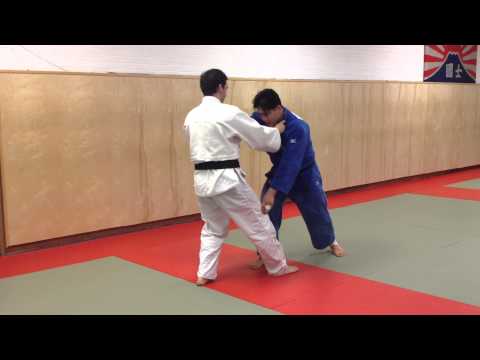
Position yourself to the left side of uke's advancing right foot. Your left foot is your base. Your sweeping right foot is positioned and ready to intercept.
As uke's right foot lands and weight fully transfers onto it, sweep the outside of their ankle/foot with the sole of your right foot in a lateral sweeping motion. Simultaneously pull uke's sleeve arm in the direction of the sweep (forward and slightly down). The timing is everything — sweep at peak weight transfer.
- 1
Create movement and read uke's stepping pattern
Pull-push uke into a walking pattern using your grips. Watch for the moment they step forward with their right foot. De-Ashi-Barai lives and dies by timing.
- 2
Position your base foot
Your left foot is your base. Step so you are positioned to the left side of uke's advancing foot, able to sweep across your body without overreaching.
- 3
Wait for peak weight transfer
The attack window is the instant uke's foot lands and full body weight transfers onto it. Too early and their foot is still mobile. Too late and they are planted and stable.
- 4
Sweep the ankle with your right foot
Sweep the outside of uke's ankle in a flat, lateral motion using the sole of your foot. The sweep direction is across uke's direction of travel.
- 5
Pull with your sleeve grip to amplify
As you sweep, pull uke's sleeve arm forward and slightly downward in the same direction as the sweep. This rotational pull amplifies the sweeping action.
What Makes It Work
- Timing is the entire technique. De-Ashi-Barai cannot be forced — it must be timed to intercept the advancing foot.
- The sweep is flat and lateral — sweeping across the ground, not upward. A low sweep is more effective than a high one.
- Create the stepping pattern you want to exploit. Use your grips to initiate movement in uke that produces the advancing step.
- The attack window is the instant the heel contacts the mat and weight fully commits. Sweep immediately at heel-contact — sweeping during flight misses; waiting until they are planted loses the window.
What to Avoid
Sweeping too early — foot is still moving
Wait until the foot has landed. Sweeping a moving foot just pushes it aside without unbalancing uke.
Sweeping too late — uke is fully planted
You must catch the foot at peak weight transfer. If uke is stable, the window has closed.
Sweeping upward rather than laterally
The sweep is a flat, horizontal motion across the ground. Think of sweeping a ball, not kicking it upward.
Not creating movement — waiting passively
Generate uke's movement with your grips. Push-pull them into a stepping rhythm so you control when they step.
Best Moments to Apply De-Ashi-Barai
De-Ashi-Barai is most effective when uke is moving — walking forward, stepping in to attack, or returning from a missed throw. Against a static uke it is very difficult. Excellent surprise technique when uke expects a grip fight — the foot sweep arrives from an unexpected direction.