Quick Facts
- Category
- Nage-Waza
- Subcategory
- Yoko-Sutemi-Waza
- Difficulty
- Intermediate
- Belt Level
- 4th kyu, 3rd kyu
Yoko-Otoshi is a side sacrifice throw in which tori steps across in front of uke's advancing leg or both legs, drops laterally to the side, and extends their own leg to block uke's shins or ankles while using an arm pull to topple uke sideways. The throw is from the classical Gokyo no Waza (originally placed in the second group). It differs from Tani-Otoshi in that the drop is to the side — perpendicular to uke's line of travel — rather than directly behind. The side drop mechanics mean tori falls perpendicular to uke while the blocking leg intercepts forward movement, creating a lateral topple.
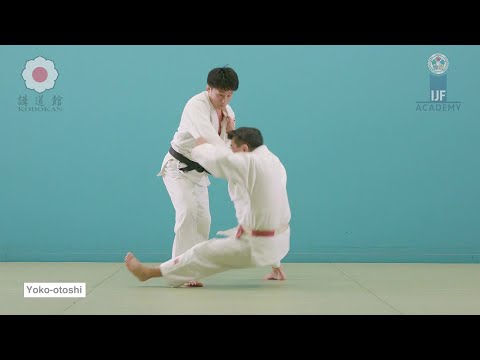
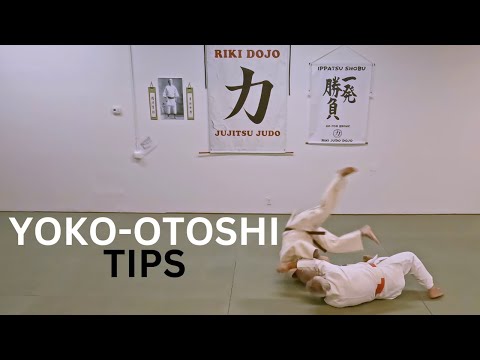

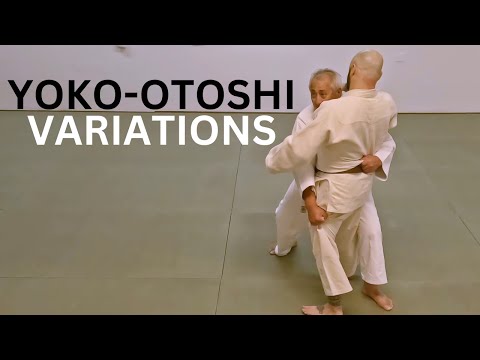
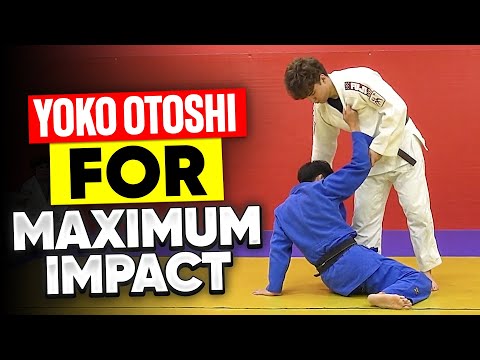
Yoko-Otoshi — Step by Step
Pull uke forward and diagonally to the side — typically with the sleeve grip pulling across tori's front — to displace uke's weight laterally. As uke's weight shifts in that direction and their forward movement is already committed, the combination of lateral pull and forward shin block creates a kuzushi that is both sideways and rotational.
Step your lead foot across and in front of uke's advancing shin or ankle — positioning it as a lateral barrier. Drop your body to the side, extending your body perpendicular to uke. Your extended arm (sleeve grip) creates the blocking line along uke's advancing legs.
As you drop to the side, your extended leg (or arm along the mat) blocks uke's shin-level forward progress. The sleeve-grip pull topples uke's upper body sideways and forward over the blocking barrier. Uke falls to the side — perpendicular to their original direction of travel.
- 1
Create forward movement in uke
Use your grips to pull uke forward and toward the side you intend to throw. Uke must be stepping forward — Yoko-Otoshi requires forward momentum to exploit.
- 2
Step across in front of uke's advancing leg
Step your foot across and in front of uke's forward leg (or between uke's legs for a two-legged block). This step positions your leg as a lateral shin-level barrier.
- 3
Drop to the side perpendicular to uke
Drop your body to the same side as your blocking leg, falling perpendicular to uke's line of movement. This is a sacrifice — you are deliberately going to the mat to create the throw.
- 4
Extend your body and arm as a block
As you fall, extend your leg and/or arm along the mat at uke's shin level to create the barrier. Your extended position across uke's path is the structural element of the throw.
- 5
Pull uke's arm to complete the sideways topple
With your sleeve grip, pull uke's arm laterally and downward as you fall. Uke's forward momentum is redirected sideways over your blocking limb, and they fall beside you.
What Makes It Work
- Yoko-Otoshi is a side throw — the drop is perpendicular to uke's forward movement, not behind them (which would be Tani-Otoshi).
- The throw requires forward momentum in uke. Against a static uke, the side drop is easily avoided by stepping.
- The blocking element is at shin or ankle level — the barrier is low and intercepts forward movement of the legs.
- This is a sutemi (sacrifice) throw — tori must commit fully to the drop. A hesitant, half-committed fall fails to create the blocking barrier.
- The arm pull direction is the same as the fall direction — lateral and forward, not straight backward.
What to Avoid
Dropping directly behind uke instead of to the side
Yoko-Otoshi falls to the side (perpendicular). Falling directly behind creates Tani-Otoshi mechanics. Position your body perpendicular to uke's line of travel.
Attempting on a static, non-moving uke
Create forward movement with your grips before dropping. Without uke's forward momentum, they simply step over the blocking leg.
Block leg too high — uke steps over it
The blocking barrier should be at shin or ankle level. A thigh-level block is too high and can be stepped over.
Half-hearted sacrifice — falling slowly and failing to create the barrier
Commit to the drop fully. Yoko-Otoshi must be a decisive lateral fall to create an effective blocking position.
Best Moments to Apply Yoko-Otoshi
Yoko-Otoshi is most effective when uke is stepping aggressively forward — during an attack entry, after a failed grip fight, or when uke is charging into you. The throw works as a counter to powerful forward pressure. It can also be applied as a sacrifice option when uke's guard is very tight from above but their forward step exposes the shin level.