Quick Facts
- Category
- Nage-Waza
- Subcategory
- Te-Waza
- Difficulty
- Advanced
- Belt Level
- 2nd kyu, 1st kyu, 1st dan
Yama-Arashi is a powerful and technically demanding te-waza associated with the legendary judoka Saigo Shiro. Tori applies a high sleeve grip and a deep collar or sleeve grip, then executes a sweeping rotational throw that combines elements of Seoi-Nage and a large sweeping arm action — projecting uke with tremendous force in a storm-like arc. It is classified as te-waza but has characteristics of both shoulder throws and sweeping throws.
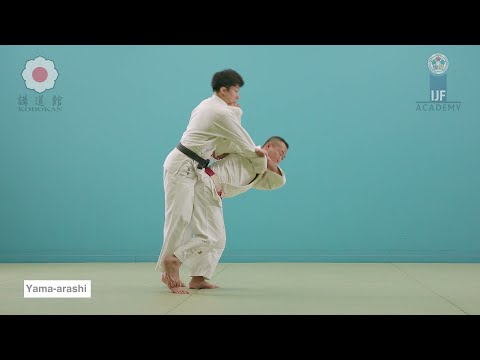
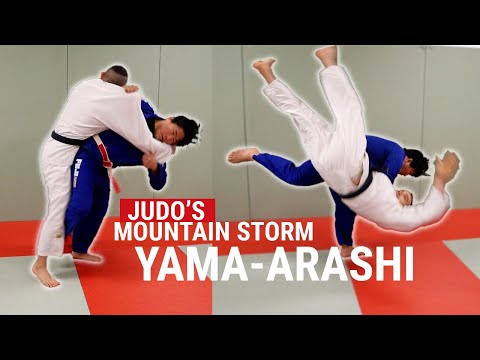
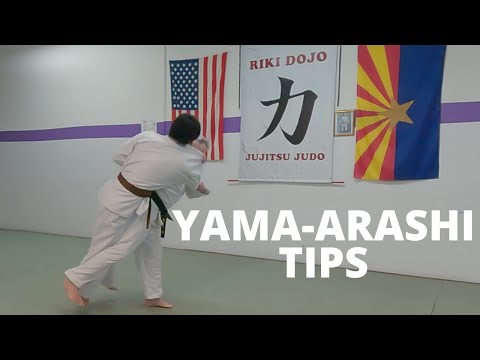
Yama-Arashi — Step by Step
Kuzushi is created by a high, pulling action on uke's right sleeve — lifting uke's arm high and pulling them forward and to their right front corner. The lapel or second grip is used to drive uke's upper body into rotation. The high sleeve creates an off-balance that uke cannot easily counter by lowering their hips.
Step deeply in with the right foot, rotating to face the same direction as uke. The entry is similar to Seoi-Nage, but the left arm — gripping high on the sleeve or lapel — maintains an elevated, sweeping position rather than wrapping under the armpit. The body entry is tight against uke's chest.
Execute a powerful rotational movement — tori's body rotates forward while the high sleeve arm sweeps uke's right arm in a large downward arc. The combination of body rotation and the sweeping arm action creates a storm-like force that projects uke forward and over. The throw can be completed standing or with a partial drop.
- 1
Establish a high sleeve grip
Grip uke's right sleeve as high as possible — near the elbow or even the upper arm. This elevated grip is the key mechanical feature of Yama-Arashi.
- 2
Create kuzushi with upward pull
Pull uke's right arm upward and toward their right front corner. The high grip amplifies the destabilizing effect. Uke's right shoulder rises.
- 3
Step in and turn
Step the right foot in front of uke, between their feet, and pivot to face the same direction. Your back presses to uke's chest as in Seoi-Nage entry.
- 4
Initiate the sweeping arm action
With the high sleeve grip, begin a large downward sweeping arc — bringing uke's arm forward, down, and across. This creates the rotational storm force.
- 5
Complete the rotational throw
Your body rotates fully forward as the sweeping arm drives uke's upper body over. Uke is projected in a large arc to the mat.
What Makes It Work
- The high sleeve grip is the defining feature — without it, the throw becomes a standard Seoi-Nage. The elevation of the grip creates the unique sweeping arc.
- The sweeping arm action must be large and continuous — like a storm sweeping through. Short, jerky pulls do not generate the necessary rotational force.
- Body rotation and the arm sweep must be synchronized. Arm-only or body-only effort produces a weak, easily-countered throw.
- Yama-Arashi requires exceptional timing and sensitivity — it is a high-level throw that should not be attempted without solid foundation in shoulder throw mechanics.
What to Avoid
Gripping at the wrist instead of high on the sleeve
The grip must be at the elbow or higher. A wrist grip lacks the leverage needed for the sweeping arc and limits the technique to a standard Seoi entry.
Insufficient body rotation
The full body must rotate forward through the throw. Half-rotations leave uke on top of tori rather than projected forward.
Treating Yama-Arashi as simply a strong Seoi-Nage
The sweeping arm arc is distinctive. Focus on the large circular motion of the sleeve arm rather than just a forward shoulder entry.
Applying without sufficient kuzushi
Yama-Arashi requires uke's arm and shoulder to be elevated before entry. Attempting without the high kuzushi means uke can resist the entry.
Best Moments to Apply Yama-Arashi
Yama-Arashi is most effective against opponents with a stiff, upright posture where the high sleeve grip can be established. It is a specialized technique for practitioners who have mastered Seoi-Nage and shoulder throw mechanics and want to develop a high-power variation. In competition it is used as a surprise element against opponents who have defended standard Seoi-Nage entries.