Quick Facts
- Category
- Nage-Waza
- Subcategory
- Ma-Sutemi-Waza
- Difficulty
- Advanced
- Belt Level
- 2nd kyu, 1st kyu, 1st dan
Ura-Nage is a powerful rear sacrifice throw in which tori wraps both arms around uke's body from behind or from the side, falls backward, and arches their back to project uke over and backward to the mat. It is one of the most spectacular throws in judo, capable of landing uke directly on their back for ippon. Ura-Nage is primarily used as a counter technique — catching uke mid-throw — and requires the courage to commit to a full backward arch with uke's weight on top of you.
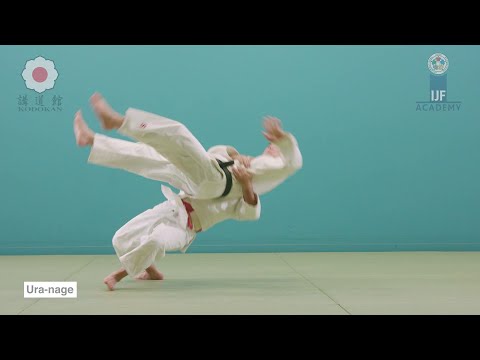

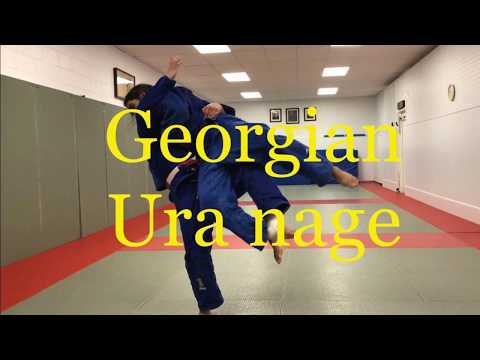

Ura-Nage — Step by Step
Ura-Nage is typically applied when uke has already committed to a forward throw attempt. Uke's own forward commitment and body positioning create the kuzushi condition — as uke enters for their throw (often a hip throw or shoulder throw), they load their weight onto tori, giving tori the leverage to apply Ura-Nage.
As uke enters for their throw (for example, a hip throw entry), step to the side and slightly behind uke, wrapping both arms around uke's waist from behind or from the side. Your chest presses against uke's back or side. Both arms lock around uke's midsection firmly. Your feet should be close to uke's feet.
With uke locked in your arms, fall backward and simultaneously arch your back powerfully. The arch of the back throws uke upward and over, projecting them in an arc over your body to land on the mat behind your head. The combination of the backward fall and the arching motion provides the rotational power.
- 1
Recognise uke's throw entry
Identify the moment uke commits to a throw entry — particularly when they turn their back to you for a hip or shoulder throw.
- 2
Step behind and wrap both arms
Step to uke's side and slightly behind, wrapping both arms firmly around uke's waist. Your chest presses against uke's back or side.
- 3
Lock the grip
Clasp your hands together firmly at uke's waist or lower chest. The grip must be secure before initiating the fall.
- 4
Fall backward with commitment
Commit to a full backward fall, keeping uke wrapped tightly in your arms. Your back arches as you fall.
- 5
Arch the back and project uke
As you hit the mat, arch your back powerfully, driving your hips and chest upward. Uke's body is thrown upward and arcs over your body to land behind you.
What Makes It Work
- Commitment is non-negotiable — a partial backward fall with hesitation results in you landing under uke with no throw.
- The back arch during kake is the throwing power source — without a full arch, uke is only dropped, not thrown.
- Both arms must lock firmly around uke before the fall; if uke slips free during the fall, the throw is lost and you are on your back.
- Timing with uke's throw entry is critical — the window when uke is mid-entry and their weight is committed is the only effective entry point.
What to Avoid
Half-committing to the backward fall
Ura-Nage requires full commitment. A hesitant half-fall places tori on their back with uke on top — a terrible position. Either commit fully or don't attempt it.
Gripping only with the arms rather than locking the hands
Clasping hands together provides a rigid lock that holds uke even during the arch. Loose arm pressure allows uke to escape.
Attempting the throw when uke is not committed to an entry
Ura-Nage applied against a balanced, defensive uke is exhausting and rarely successful. Wait for uke to commit to an attack.
Not arching the back during kake
Without the back arch, uke is only dropped onto the mat in a forward direction. The arch is what sends uke over in the powerful arcing trajectory.
Best Moments to Apply Ura-Nage
Ura-Nage is almost exclusively a counter technique in competition. It is most effective when countering hip throws (koshi-waza) and shoulder throws (seoi-nage), where uke turns their back directly into your arms. It can also counter sacrifice throws when uke ducks under. It is a high-reward, high-risk technique — when it scores, it typically scores ippon.