
Quick Facts
- Category
- Katame-Waza
- Subcategory
- Osaekomi-Waza
- Difficulty
- Intermediate
- Belt Level
- 3rd kyu, 2nd kyu
Ura-Gatame is a rear hold-down where tori controls uke from behind — from the opposite side of uke's chest. Tori is on their back or side behind uke, with uke's back against tori's chest, applying a hold that controls uke's arms and upper body. It is a less conventional hold arising from specific throw and transition scenarios where tori ends up behind uke.
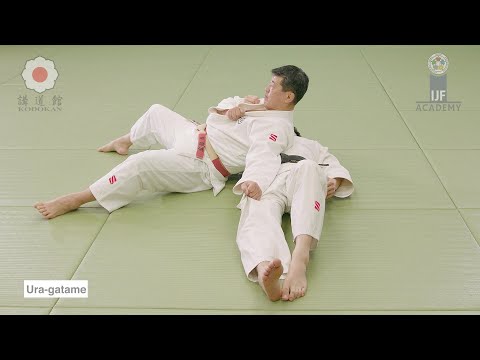


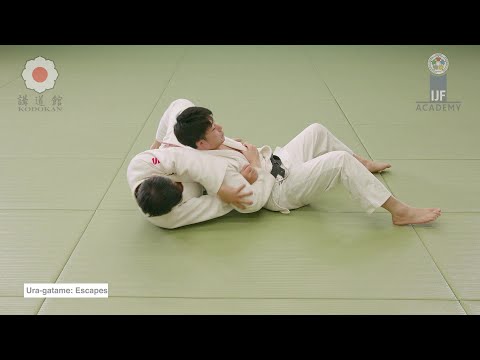
Ura-Gatame — Step by Step
- 1
End up behind uke after a throw or transition
Ura-Gatame typically arises when tori ends up on uke's back side after a throw — particularly from rear throws or rolling transitions.
- 2
Press uke's back against your chest
Uke's back is against tori's front. Use your body weight to keep uke pressed to the mat.
- 3
Control uke's arms from behind
Reach around uke to control their arms — trapping them or gripping their sleeves to prevent escape.
- 4
Wrap and secure uke's body
Wrap your arms around uke from behind to create the holding force. Body weight from behind presses uke to the mat.
- 5
Maintain position and prevent rolling
Keep uke from rolling. Your body behind them prevents one direction; your arm and leg positioning prevent the other.
What Makes It Work
- Ura-Gatame uses the rear position — tori's chest against uke's back — to apply holding force.
- Arm control from behind is essential. Uke has full range of motion for both arms; secure them.
- The hold requires body weight applied from behind and to the side — not just arms wrapping around uke.
- Ura-Gatame often leads naturally to rear choke applications (Hadaka-Jime, Okuri-Eri-Jime).
What to Avoid
Insufficient body weight — relying only on arms
Apply body weight from behind to press uke to the mat. Arms alone cannot hold an active uke.
Not securing uke's arms
With uke's back exposed, their arms have full freedom. Control them to prevent pushes and escapes.
Allowing uke to roll through to face you
Use leg positioning to block uke's forward roll. Hook their leg or block with your knee.
Not transitioning to choke when available
Ura-Gatame presents clear access to rear chokes. If a choke setup is available, consider transitioning.
Best Moments to Apply Ura-Gatame
Ura-Gatame arises from throws that send tori to uke's rear — certain sacrifice throws, transition scrambles, or when uke rolls and tori maintains contact. It is a transitional hold often used briefly before transitioning to a more dominant position or a rear choke.