
Quick Facts
- Category
- Nage-Waza
- Subcategory
- Yoko-Sutemi-Waza
- Difficulty
- Intermediate
- Belt Level
- 3rd kyu, 2nd kyu
Uki-Waza is a side sacrifice throw where tori falls to the side while pulling uke's upper body in the same direction, creating a "floating" throw effect. It is one of the five classical side sacrifice throws of judo and appears in the Nage-no-Kata. The technique is characterized by a smooth, floating lateral pull that lifts uke off their base and dumps them to the mat.
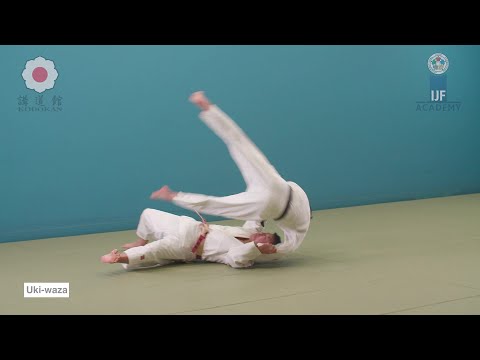



Uki-Waza — Step by Step
Pull uke strongly to the side — in the direction tori will fall. Both sleeve and lapel grips pull uke's upper body to the side, breaking balance to uke's front corner. Uke's weight floats to one side and they begin to lose their stable base.
Step forward with your right foot past uke's right foot — placing it at uke's side. Begin falling to your left as you step, pivoting your body to face uke from the side. Your body leans into the falling direction as you draw uke with the grips.
Fall fully to the side, pulling uke's upper body with both grips as you fall. Your left side falls to the mat while your grips bring uke's upper body floating over and to the mat beside you. The "floating" quality comes from the smooth, continuous pull that lifts uke over rather than forcing them down.
- 1
Pull uke to the side with both grips
Pull the sleeve and lapel grips to the side — toward your falling direction. Uke floats off their base.
- 2
Step forward and to the side of uke
Step your right foot forward past uke's right foot, positioning it to uke's side. Begin leaning into the fall.
- 3
Fall to your left side
Commit to the side fall, bringing your left side fully to the ground.
- 4
Pull uke over and down
As you fall, both grips pull uke's upper body in the direction of the fall — forward and to the side — floating them over.
- 5
Land and allow uke to complete the arc
Tori lands on the side while uke, pulled forward and sideways, continues in their arc to land on the mat.
What Makes It Work
- The "floating" quality is created by the smooth, continuous pull of the grips as tori falls. Think of drawing uke through the air horizontally.
- The step placement is critical — your stepping foot gives the directional base for the fall.
- Total commitment to the side fall is required. Stopping partway through leaves tori in a vulnerable, half-fallen position.
- Uki-Waza is particularly valuable as a classical technique demonstrating the sutemi-waza principle.
What to Avoid
Stopping the fall partway
Commit fully to the side fall. Any hesitation leaves you stuck at an angle without completing the throw.
Pulling uke down instead of floating them sideways
The pull should have a lateral, floating quality — pulling uke out and over, not directly downward.
Stepping foot placed behind uke instead of to the side
The step should place your foot beside or slightly ahead of uke's foot, not behind. Behind-the-foot placement changes the fall angle.
Losing grip during the fall
Maintain both grips throughout. The grips are the connection that pulls uke over.
Best Moments to Apply Uki-Waza
Uki-Waza is effective when uke is advancing or has forward momentum — the floating pull redirects their energy sideways. It is most commonly practiced in kata and used in randori as a flowing sacrifice when uke's lateral balance is broken.
Combination Sequences
Attack these first
Follow up with