Quick Facts
- Category
- Nage-Waza
- Subcategory
- Koshi-Waza
- Difficulty
- Intermediate
- Belt Level
- 4th kyu, 3rd kyu
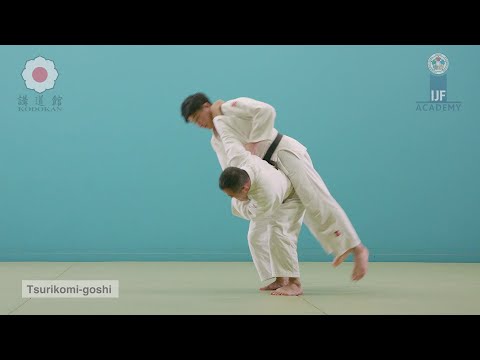
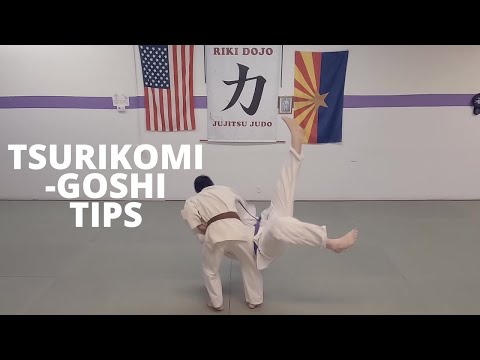
Tsurikomi-Goshi is a hip throw that adds a lifting collar grip to the standard hip throw mechanics. Tori grips uke's collar high with the lapel hand and simultaneously pulls the sleeve upward — this "lifting-pulling" (tsuri-komi) action on the collar drives uke onto their toes and breaks their balance more effectively than a standard grip. The hip then acts as the fulcrum for the throw.
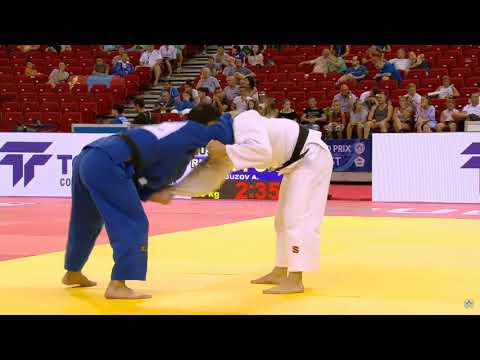
Tsurikomi-Goshi — Step by Step
The tsuri-komi (lifting-pulling) action is the defining feature: tori pulls uke's lapel upward with the collar grip while simultaneously pulling the sleeve forward. The collar grip lifts uke's collar and chin, forcing them to rise up onto their toes. This combination of upward collar pressure and forward sleeve pull creates powerful forward kuzushi that is difficult for uke to resist.
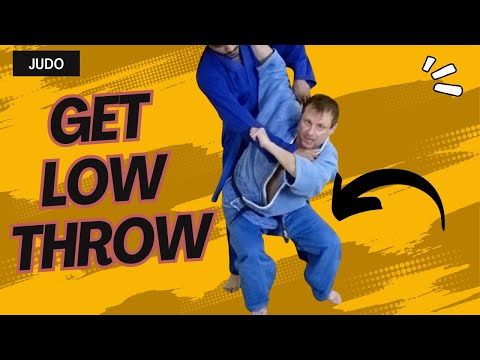
Step the right foot in between uke's feet and pivot to place your back against uke's chest. The collar hand grips high — near uke's right lapel — and pulls upward to keep uke rising. The entry is compact with back-to-chest contact. Bend the knees to position the hip below uke's hip.
Straighten the legs to load uke onto the hip, maintaining the upward collar pull throughout. Bend forward at the waist and pull both grips forward — the collar pull guides uke's upper body over the hip while the sleeve pull directs their arm. Uke is projected over the hip and to the mat.
- 1
Grip the collar high and establish sleeve grip
Grip uke's right lapel near the collar with your left hand. Grip the sleeve with your right hand. The collar grip should be high — near uke's chin level.
- 2
Apply tsuri-komi — lift the collar, pull the sleeve
Pull the collar upward while simultaneously pulling the sleeve forward. This drives uke's chin up and forces them onto their toes. This is the defining kuzushi of the technique.
- 3
Step in and pivot
Step right foot in between uke's feet. Pivot to place your back against uke's chest. Keep the collar pull active throughout the entry.
- 4
Position the hip and bend the knees
Your right hip must be below and in front of uke's hip. Bend your knees as you enter so the hip is at the correct level.
- 5
Throw over the hip
Straighten your legs, bend forward at the waist, and pull both grips forward. Uke is levered over your hip onto the mat.
What Makes It Work
- The upward collar pull is the key feature — it forces uke to rise, making the hip entry much more effective than with a standard lapel grip.
- The collar grip must stay high and pulling upward throughout the throw. Dropping the collar grip negates the tsuri-komi effect.
- The two grips work together: collar lifts uke up, sleeve pulls uke forward. Both must be active simultaneously for maximum kuzushi.
- The hip entry mechanics are the same as O-Goshi and Uki-Goshi — mastery of those techniques simplifies learning Tsurikomi-Goshi.
What to Avoid
Collar grip too low — no lifting effect
The collar grip must be high, near uke's chin. A low grip cannot lift the collar and provides no tsuri-komi action.
Dropping the collar pull during the entry step
Maintain the upward collar pull from the moment of kuzushi through to the completion of the throw. Dropping it allows uke to lower and defend.
Collar and sleeve pulling in the same direction
The collar pulls upward, the sleeve pulls forward. They are two different vectors that together create the powerful rotational kuzushi.
Hip too high during entry
Bend the knees sufficiently to place the hip below uke's hip. A high hip cannot act as a fulcrum for a throw.
Best Moments to Apply Tsurikomi-Goshi
Tsurikomi-Goshi is particularly effective against opponents with a bent-forward posture — the upward collar pull straightens their posture and drives them up onto their toes, creating the kuzushi needed for the hip throw. It is also used when a standard hip throw grip has been blocked, as the high collar grip bypasses sleeve defenses.