Quick Facts
- Category
- Katame-Waza
- Subcategory
- Shime-Waza
- Difficulty
- Intermediate
- Belt Level
- 3rd kyu, 2nd kyu
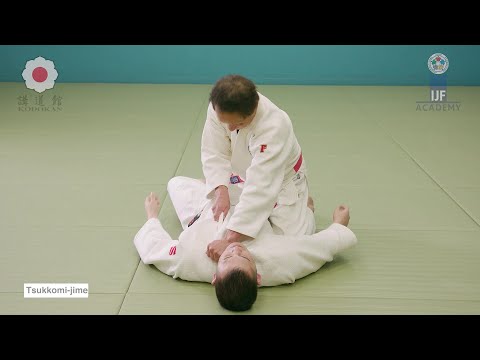
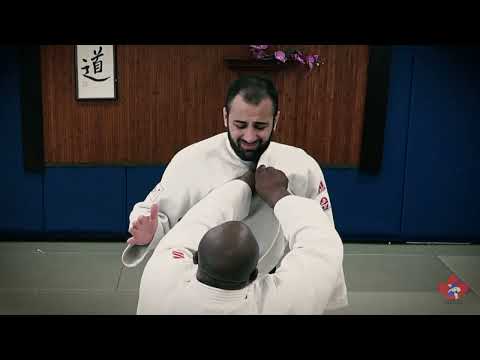
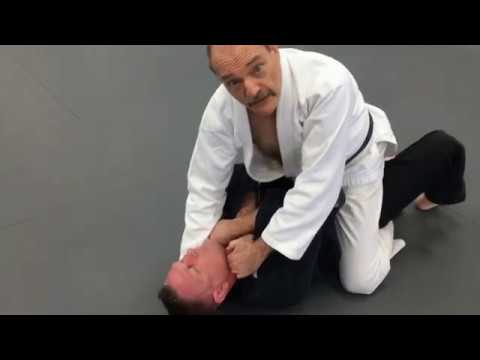
Tsukkomi-Jime is a collar choke where one or both hands thrust into uke's collar in a specific way to create a choking pressure. "Tsukkomi" means to thrust in. Tori grips uke's collar with cross-grip or palm-upward grip and drives the knuckle or forearm into the side of uke's neck, compressing the carotid. It is a technically precise choke that leverages the collar for additional control.
Tsukkomi-Jime — Step by Step
- 1
Establish collar grip
Grip uke's lapel near the collar with a cross-grip (right hand reaching to uke's right collar). A deep grip close to the collar is required for the thrusting action.
- 2
Position the gripping hand — palm up or cross grip
Turn the gripping hand palm-upward. The edge of the forearm near the thumb side should face the neck. Or use a cross-grip where one hand reaches deep to the opposite collar.
- 3
Thrust the grip into uke's neck
Drive the forearm edge or knuckles into the side of uke's neck — compressing the carotid. The thrusting motion gives the technique its name.
- 4
Add secondary grip or pressure
The free hand can assist by pushing or pulling to increase neck pressure, or gripping the collar on the other side.
- 5
Maintain consistent compression
Hold the thrusting compression steady. Combined with body weight in a top position, this creates effective carotid pressure.
What Makes It Work
- The "thrust" mechanics — driving the edge of the hand or forearm into the neck — is the defining feature. It is not a squeeze; it is a thrusting press.
- Collar depth matters — a shallow collar grip cannot reach the neck effectively. Grip deep, near uke's collar.
- The palm-upward grip position rotates the forearm to present its sharpest edge to the neck.
- Body weight from a top position amplifies the thrusting pressure significantly.
What to Avoid
Shallow collar grip — edge of forearm cannot reach neck
Grip deep into the collar — as close to uke's neck as possible. The forearm or knuckle must contact the carotid, not the lapel.
Thrusting at the trachea instead of the carotid
Target the sides of the neck, not the front. Tracheal pressure is illegal and dangerous.
No body weight addition
Apply the choke from a top position and drive body weight through the arms. Without weight, pure arm force is limited.
Palm-down grip — wrong forearm rotation
The palm-up (or thumb-toward-neck) grip presents the correct edge of the forearm. Palm-down places the flat surface on the neck with less compression.
Best Moments to Apply Tsukkomi-Jime
Tsukkomi-Jime is applied from top positions — mount, side control, or knee-on-belly — where the collar is accessible. It is effective when uke's defense focuses on pushing tori's arms away, as the thrusting action drives inward despite outward resistance.