Quick Facts
- Category
- Nage-Waza
- Subcategory
- Ma-Sutemi-Waza
- Difficulty
- Intermediate
- Belt Level
- 3rd kyu, 2nd kyu
Tawara-Gaeshi is a sacrifice throw named for its resemblance to rolling a heavy rice bale. Tori picks up uke bodily — wrapping both arms around uke's torso — and falls backward while tipping uke over, rolling them like a heavy barrel or rice bale to land on their back. It is classified as ma-sutemi-waza because tori falls directly backward.
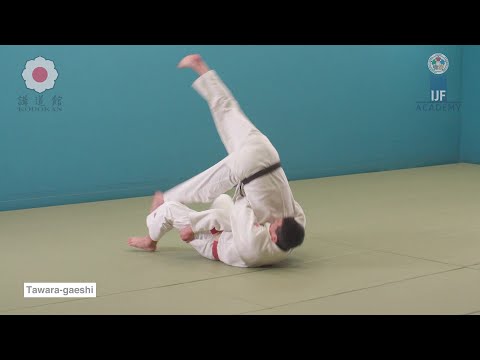

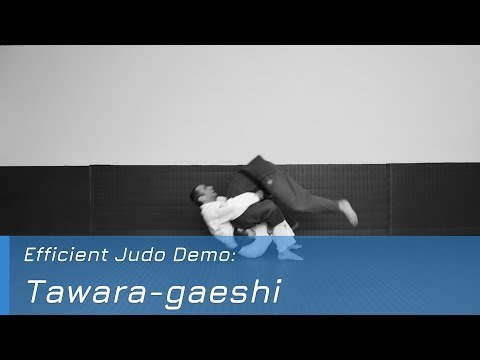
Tawara-Gaeshi — Step by Step
Kuzushi is created by the lifting and tipping action. Tori wraps around uke's torso and lifts them — uke's feet may leave the ground. Once lifted, uke's balance is completely broken as their center of mass is in tori's arms. The lift and subsequent backward fall are the combined kuzushi-kake action.
Secure both arms firmly around uke's torso, typically under the arms or around the waist. The grip should be deep — hands clasped or gripping the belt at the back. Position your hips against or below uke's hips to use them as the pivot point for lifting.
Lift uke using the leg drive (standing up) and arm wrap. Once uke is lifted, fall backward — the sacrifice. As tori falls back with uke in their arms, the momentum tips uke up and over. Tori rolls back and uke is deposited onto the mat, resembling the rolling of a heavy rice bale.
- 1
Wrap both arms around uke's torso
Secure a deep two-arm wrap around uke's midsection — under the arms or around the waist. Clasped hands or a belt grip at the back.
- 2
Position hips below uke's center
Bend your knees and place your hips lower than uke's hips to create the lever point for the lift.
- 3
Lift uke off the ground
Drive upward through your legs, lifting uke entirely off the ground. The arms maintain the encircling grip.
- 4
Fall backward — the sacrifice
With uke lifted, fall straight backward. Your backward fall takes uke with you.
- 5
Roll and deposit uke to the mat
As you fall, tip uke up and over your body. Roll through and uke lands on the mat beside or in front of you.
What Makes It Work
- The grip must encircle uke fully — a partial wrap allows uke to squirm free during the lift.
- Lift first, then sacrifice. Attempting the fall before lifting merely drops you under uke with no throw.
- The fall should be controlled — not a crash. Tori uses the ground to roll through the technique safely.
- Follow through to a hold-down. After depositing uke, transition quickly to osaekomi-waza.
What to Avoid
Falling without lifting uke first
Lift uke off the ground before sacrificing. Falling without the lift just puts you on your back under uke.
Loose wrap — arms not fully encircling
The wrap must be secure all the way around uke's torso. A loose grip fails when uke resists the lift.
No follow-through to hold-down
After the roll and throw, immediately transition to a hold-down. The throw is incomplete if uke is simply deposited and released.
Falling to the side instead of straight back
Fall straight backward (ma-sutemi). Falling to the side changes the throw direction and is less controlled.
Best Moments to Apply Tawara-Gaeshi
Tawara-Gaeshi is used when uke is defensively bent forward with a strong lowered posture, or when uke has attempted a leg grab and is in a head-down position. The encircling grip takes advantage of uke's bent-over posture. It is also useful in newaza standing transitions when uke is on all fours.