
Quick Facts
- Category
- Nage-Waza
- Subcategory
- Yoko-Sutemi-Waza
- Difficulty
- Intermediate
- Belt Level
- 3rd kyu, 2nd kyu
Tani-Otoshi is a side sacrifice throw primarily used as a counter technique. When uke bends forward — particularly during the entry for a hip throw or Seoi-Nage — tori steps behind them, loads their weight against uke's back, and falls to the side while pulling uke over and backward. It is one of the most reliable counter throws in judo.
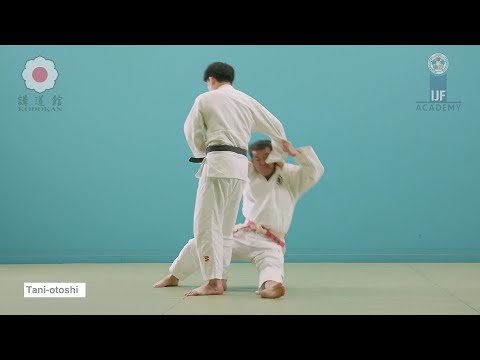
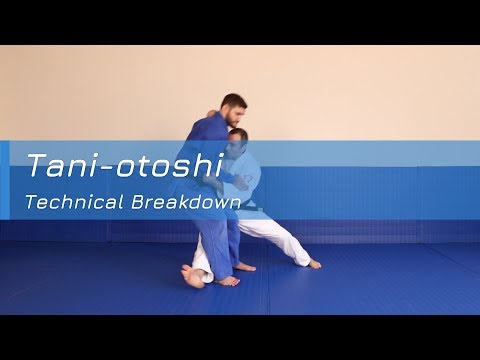


Tani-Otoshi — Step by Step
Tani-Otoshi creates its kuzushi reactively: uke's own forward bend (during their attack entry) creates the backward imbalance that Tani-Otoshi exploits.
Step your right foot to the outside-rear of uke's stance, behind and to the side of both their feet. Lean your body weight into uke's lower back. Keep your hips against their lower body.
Drop to your right side, pulling uke's arms and rotating their upper body toward you while your right leg sweeps both of uke's legs forward. The combination of your falling weight, arm pull, and leg sweep topples uke backward over your falling body.
- 1
Recognize and react to uke's forward entry
Tani-Otoshi is primarily a counter. As uke enters for a hip throw or other forward technique and bends forward, the opportunity window opens.
- 2
Step behind uke with your right foot
Step your right foot to the outside-rear of uke's stance, behind and to the side of both their feet. Your leg creates the surface onto which you will fall.
- 3
Load your weight into uke's lower back
Drive your hips and body weight into uke's lower back. Your chest should press against their back, pushing them forward over your foot.
- 4
Drop to your right side and pull
Fall to your right side while simultaneously pulling both of uke's arms downward and toward you. The drop and pull work together.
- 5
Sweep with the right leg as you fall
As you drop, sweep your right leg into uke's legs or ankle to remove their base. Combined with the arm pull and body drop, uke falls backward.
What Makes It Work
- Timing is critical — Tani-Otoshi must react to uke's forward movement, not attack a stable upright uke.
- The body weight load into uke's back is essential — without it, uke simply steps away.
- Pull uke's arms downward and across your body during the fall, not just backward.
- This is a sacrifice throw — you are dropping to the mat deliberately.
What to Avoid
Attempting on an upright, stable uke
Tani-Otoshi requires uke to be bent forward. Against an upright uke, they simply step backward and you fall alone.
Stepping beside uke rather than behind them
Your right foot must go behind both of uke's feet. Beside them means no leg barrier.
Not driving body weight into uke's back
Your body weight pressing into their back is what prevents them from stepping away. Without this, the throw fails.
Best Moments to Apply Tani-Otoshi
Tani-Otoshi is most commonly used as a counter to Seoi-Nage, hip throws, or any technique that requires uke to bend forward. As uke bends forward into their throw, their weight is committed forward — step behind them and drop. Also works proactively when uke is bent over in a defensive posture.