Quick Facts
- Category
- Nage-Waza
- Subcategory
- Te-Waza
- Difficulty
- Intermediate
- Belt Level
- 4th kyu, 3rd kyu
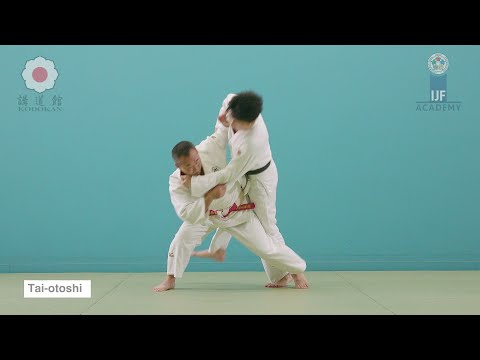
Tai-Otoshi is a hand throw that uses a leg barrier rather than a hip load to unbalance and rotate the opponent to the mat. Unlike hip throws, tori does not lift uke — instead, tori's extended right leg acts as a blocking post while rotational force spins uke over it.
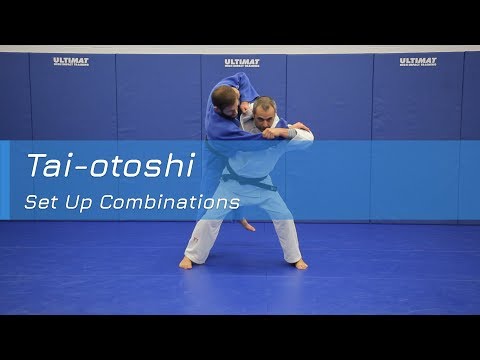
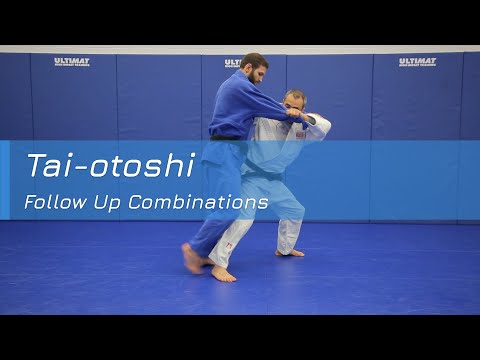
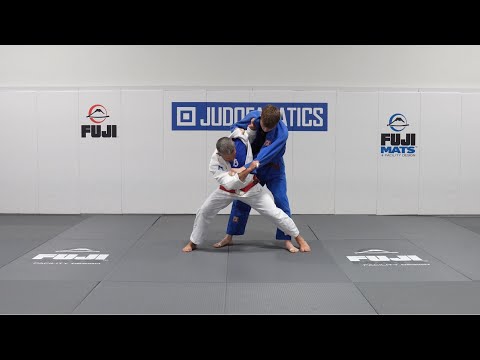

Tai-Otoshi — Step by Step
Pull uke sharply forward and to their right front corner. Your sleeve hand (right) drives upward and outward, while your lapel hand (left) pulls forward across your body. Uke must be leaning forward with weight shifting to their right foot.
Step your right foot across to the right side of uke's right foot, then pivot and bring your left foot around so your back faces uke's chest. Extend your right leg across in front of uke's right shin — this is the barrier. Your right leg should be nearly straight, placed low across uke's lower leg.
Rotate your upper body sharply to your left while pulling strongly with both hands — your sleeve hand downward, your lapel hand across and down. This rotation sweeps uke over your extended right leg and to the mat. The throw is powered entirely by rotation, not by lifting.
- 1
Break uke's balance forward-right (kuzushi)
Pull uke's sleeve arm upward and toward their right front corner. Your lapel hand drives forward across your centerline. Uke's weight should be transferring to their right foot.
- 2
Step your right foot across
Step your right foot to the outside of uke's right foot. Your foot should be placed past their foot, not beside it — this sets the angle for the leg barrier.
- 3
Pivot and place the leg barrier
Pivot on your right foot and swing your left foot around until your back faces uke's chest. Extend your right leg across in front of uke's right shin, close to the ground. Keep it relatively straight.
- 4
Apply rotational throwing force
Twist your upper body strongly to the left. Pull uke's sleeve downward with your right hand and pull their lapel forward and around with your left. This rotation — not a lift — drives uke over your leg barrier.
- 5
Complete the throw
Continue rotating until uke's body clears your right leg and they land on the mat to your right side. Maintain grip control throughout to guide the fall.
What Makes It Work
- The right leg is a barrier, not a trip. Place it and hold it; the rotation of your upper body does the work.
- Unlike Seoi-Nage, you do not lift uke. Tai-Otoshi is purely rotational.
- The leg must be placed across uke's shin, not against their thigh — placing too high reduces leverage.
- Your body turn must be complete before applying the throw — a half-turn results in poor angle and escape for uke.
What to Avoid
Trying to lift uke instead of rotating
Tai-Otoshi throws through rotation. Think of turning a steering wheel, not lifting a box.
Leg barrier placed too high (against the thigh)
The right leg should block the shin or lower leg. Contact too high removes the mechanical advantage.
Insufficient rotation — body turn is incomplete
Your chest and hips must rotate fully away from uke before pulling. Drill the entry movement until the turn is automatic.
Pulling with arms only, no body rotation
The power comes from rotating your torso. Arms just transmit the force — they should not initiate it.
Best Moments to Apply Tai-Otoshi
Tai-Otoshi works well against taller opponents where loading them onto your back (as in hip throws) is difficult. It is extremely effective when uke steps to their right (tori's left) or when they push into you — you redirect that forward energy over the leg barrier. Excellent combination throw following O-Uchi-Gari or Ko-Uchi-Gari.