
Quick Facts
- Category
- Nage-Waza
- Subcategory
- Ma-Sutemi-Waza
- Difficulty
- Intermediate
- Belt Level
- 3rd kyu, 2nd kyu, 1st kyu
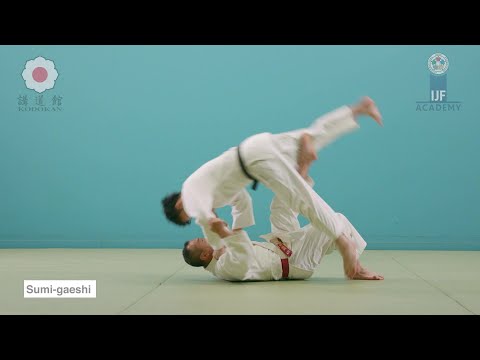
Sumi-Gaeshi is a rear sacrifice throw in which tori falls backward, places their foot in uke's inner thigh or groin area, and uses a rolling motion to lever uke over their body to the mat. The "reversal" component describes how tori uses uke's forward-pressing weight against them — as uke presses in, tori falls back and redirects that energy upward and over. It is a highly effective counter technique but requires precise timing and the confidence to commit to a backward fall.

Sumi-Gaeshi — Step by Step
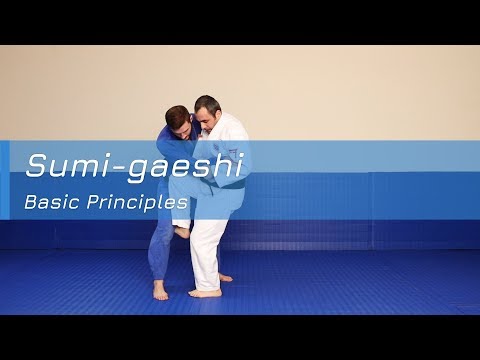
Allow uke to press into you, or pull uke forward and into you, creating a strong forward commitment from uke. As uke's weight comes forward and onto you, begin your backward fall to redirect that energy. Uke's forward momentum must be established before the sacrifice begins.
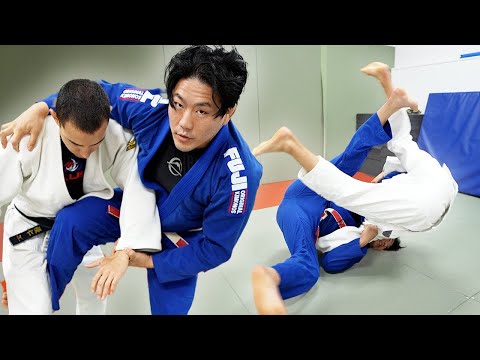
As uke presses forward, step your right foot to the outside of uke's right foot and begin falling backward. As you fall, place your left foot against the inside of uke's right thigh — the sole of the foot contacts uke's inner thigh above the knee. Your right foot hooks outside uke's right leg or posts on the mat for control.
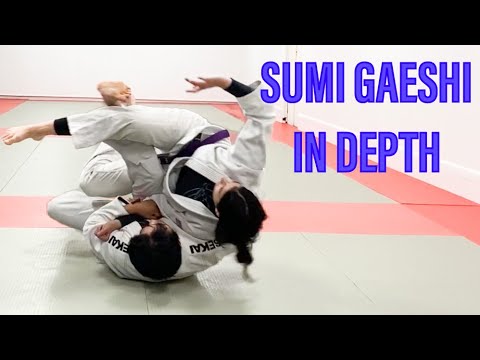
As your back meets the mat, extend your left leg powerfully, pushing uke's thigh upward and over your body. Simultaneously pull uke's sleeve arm forward and over, and roll your own body backward. Uke's forward momentum combined with the leg extension and arm pull rolls them over your body and lands them on the mat beyond your head.
- 1
Invite or absorb uke's forward pressure
Either draw uke forward with your arms or allow uke to press into you. You need uke's weight committed forward.
- 2
Begin the backward sacrifice
Step outside uke's right foot and begin falling backward in a controlled drop. Stay connected to uke through your grips.
- 3
Place the foot on the inner thigh
As you fall, lift your left leg and place the sole of the foot against uke's inner right thigh, just above the knee. Maintain firm foot contact.
- 4
Fall to your back and extend the leg
As your back reaches the mat, extend your left leg powerfully upward and over, levering uke's thigh. Your back acts as the pivot point.
- 5
Complete the roll with arm pull
Pull the sleeve arm forward and over your body while rolling your torso. Uke's body rolls over you and lands on the mat.
What Makes It Work
- The sacrifice is the technique — you must commit to falling backward. A hesitant half-fall leaves you in an exposed position on one knee.
- The foot placement on the inner thigh must be established before your back hits the mat.
- Uke's forward momentum is the fuel — without uke pressing in, the throw lacks the energy to complete the roll.
- Stay connected through your grips throughout the throw; if you lose grip during the fall, control of the throw is lost.
What to Avoid
Placing the foot on the knee instead of the inner thigh
The foot contact must be on the inner thigh, above the knee. Contact on the knee itself risks injury and reduces the lever length.
Falling back without uke's forward pressure established
Without uke pressing in, you simply fall backward with uke standing over you. Ensure uke's weight is committed forward before initiating the sacrifice.
Not extending the leg fully during kake
The leg extension must be powerful and complete — push uke's thigh up and over. A limp leg extension fails to generate the rotation needed to roll uke over.
Rolling too far and landing on your stomach
Control the roll through the arm grip and leg extension. Overshoot places you in a disadvantaged ground position.
Best Moments to Apply Sumi-Gaeshi
Sumi-Gaeshi is excellent as a counter to an aggressive forward-pressing opponent. It is also used when uke bears down for a double-leg attack or a grip-fighting forward charge. In transition to ne-waza, it naturally leads to a dominant ground position if uke lands partially on their side. It is particularly effective as a counter to poorly timed hip throw attempts.