Quick Facts
- Category
- Nage-Waza
- Subcategory
- Koshi-Waza
- Difficulty
- Advanced
- Belt Level
- 2nd kyu, 1st kyu, 1st dan
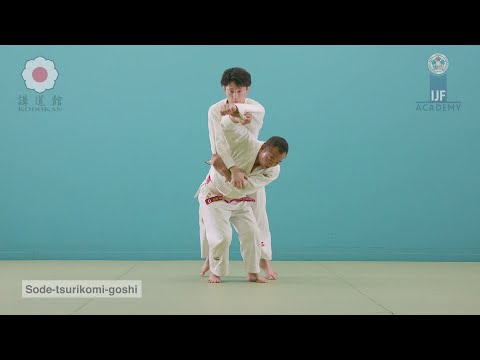
Sode-Tsuri-Komi-Goshi is an advanced hip throw executed from a two-sleeve grip. Instead of a standard lapel-sleeve hold, tori grips both of uke's sleeves — the right hand gripping uke's left sleeve at the elbow, the left hand gripping uke's right sleeve. Tori then pivots, loads uke's weight on their hip, and uses both arm pulls to rotate uke over. This grip bypasses uke's lapel defence entirely and is a favourite technique among players with a powerful two-sleeve kumi-kata style.

![Sode Tsurikomi Goshi 袖釣込腰 [Judo Techniques, Judo Throws, and Judo Ippons!] — judo technique demonstration](https://img.youtube.com/vi/7wfEARpxpd8/hqdefault.jpg)
Sode-Tsuri-Komi-Goshi — Step by Step
From a two-sleeve grip, pull uke's left arm upward and across to their right front corner while simultaneously pulling their right arm inward. The cross-pulling action destabilises uke's frame diagonally, drawing them forward and onto their toes. The double-sleeve control prevents uke from posting a stabilising grip.
Step your right foot in deep between uke's feet, toes turned outward. Pivot 180 degrees, swinging the left foot around to face the same direction as uke. Both sleeve grips are maintained throughout the turn. As you complete the entry, raise both arms to lift uke slightly, positioning your hip below their centre of gravity. Your back should press against uke's chest.
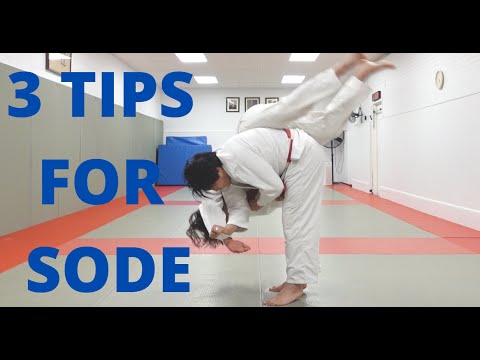
Drive your hip upward and forward while bending sharply at the waist. Both sleeve arms pull uke downward and across simultaneously — the combined pulling forces rotate uke over the hip. Release the throw with a sharp forward bend, projecting uke in a high arc to the mat.
- 1
Establish two-sleeve grip
Grip uke's left sleeve at the elbow with your right hand, and uke's right sleeve near the cuff or elbow with your left hand. Maintain active tension on both grips.
- 2
Apply cross-directional kuzushi
Pull uke's left sleeve upward and to their right front corner while drawing their right sleeve inward and downward. Uke's balance breaks diagonally to their right front.
- 3
Step in and pivot
Drive your right foot in front of and between uke's feet. Pivot sharply on the right foot, swinging the left foot around 180 degrees. Maintain the double-sleeve tension throughout.
- 4
Raise arms and load the hip
Lift both sleeve grips upward to raise uke onto your hip. Ensure your hip presses firmly into uke's hip region as you complete the entry.
- 5
Execute the throw with combined arm pull
Bend sharply forward while pulling both sleeves downward and across. Uke rotates over your hip and is projected to the mat.
What Makes It Work
- The two-sleeve grip must remain active throughout — both arms work together to control uke's frame and create rotational force.
- Hip placement follows the same principle as all koshi-waza: your hip must be in contact with uke's hip before the throw.
- The cross-directional kuzushi is more complex than a simple forward pull — the diagonal break exposes uke's front corner.
- This technique requires a fast, committed entry; a slow pivot gives uke time to post and block the hip.
What to Avoid
Gripping too close to uke's cuff (loss of leverage)
Right hand should grip at the elbow of uke's left sleeve for the most leverage. Too close to the hand reduces the mechanical advantage on uke's arm.
Arms pulling in the same direction instead of cross-direction
The kuzushi is cross-directional — one arm pulls upward, the other pulls inward. Pulling both in the same direction fails to break uke's balance.
Incomplete hip contact during entry
The pivot must be fully committed, placing your back flat against uke's chest with hip contact. A partial turn exposes your side and fails to generate hip leverage.
Attempting the throw without sufficient kuzushi
Sode-Tsuri-Komi-Goshi requires uke to be destabilised diagonally before entry. Attempting entry against a balanced uke results in a blocked throw.
Best Moments to Apply Sode-Tsuri-Komi-Goshi
Sode-Tsuri-Komi-Goshi is most effective against opponents who defend against traditional lapel grips by keeping their elbows down. The two-sleeve entry circumvents this defence. It is commonly used by players whose primary grip strategy involves sleeve control. Best applied when uke overextends a sleeve grip, opening the entry.
Variations of Sode-Tsuri-Komi-Goshi
Counters to Sode-Tsuri-Komi-Goshi
Combination Sequences
Attack these first
Follow up with