Quick Facts
- Category
- Nage-Waza
- Subcategory
- Te-Waza
- Difficulty
- Intermediate
- Belt Level
- 4th kyu, 3rd kyu, 2nd kyu
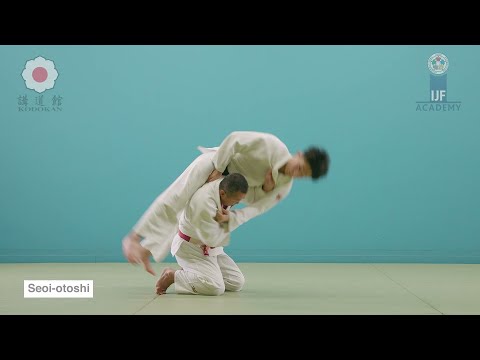
Seoi-Otoshi is a shoulder throw variant where tori drops to both knees during execution rather than remaining standing. It shares the entry mechanics of Seoi-Nage but the drop to the knees generates a more vertical, powerful projection particularly effective against taller opponents. It is widely used in competition and is one of the most reliable throwing techniques at all levels.

Seoi-Otoshi — Step by Step
Pull uke forward and upward onto their right front corner with the sleeve grip. The sleeve arm elevates uke's right arm to open space under their armpit for the entry arm. Uke's weight must be loading forward onto the balls of their feet before the drop begins.
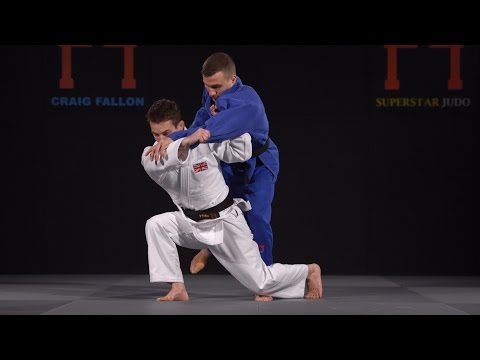
Step your right foot in between uke's feet, toes pointing in the same direction as uke's. Simultaneously drive your right arm under uke's right armpit — elbow bends upward, forearm contacts uke's chest. Begin bending your knees to initiate the drop. Your back must be tight to uke's chest with no gap.
Drop to both knees simultaneously, driving your back down and into uke. As you drop, pull uke's sleeve sharply downward and forward with your left hand. Your entry arm pushes upward under uke's armpit. The combination of the knee drop, sleeve pull, and entry arm lift projects uke forward and over your right shoulder onto the mat.
- 1
Create forward kuzushi
Pull the sleeve grip upward and forward. Uke's right elbow rises. Their weight shifts forward onto their toes.
- 2
Step the right foot in
Step your right foot between uke's feet with toes pointing in uke's direction. This anchors your entry.
- 3
Drive the right arm under uke's armpit
Slide your right arm under uke's right arm with your elbow pointing upward. Your forearm contacts uke's chest across their sternum.
- 4
Drop to both knees
Drop explosively to both knees. This creates the projection angle that lifts uke off their feet. Your back remains in contact with uke's chest.
- 5
Project uke forward
Pull the sleeve arm down and forward while the entry arm drives upward. Uke's body is projected forward and over your shoulder in an arc to the mat.
What Makes It Work
- The drop to both knees must be explosive, not gradual. A slow descent gives uke time to adjust and allows them to step over.
- Back-to-chest contact must be maintained throughout. Any gap during the drop lets uke's weight miss your shoulder.
- The sleeve pull is critical — it keeps uke's arm trapped and prevents them from posting out to break the fall wide.
- Seoi-Otoshi is particularly effective against tall opponents where a standing Seoi-Nage is difficult due to height difference.
What to Avoid
Dropping one knee at a time instead of both simultaneously
Both knees must hit simultaneously to create a level projection surface. Dropping one knee first rotates the shoulder and directs uke to the side, losing power.
Entry arm too low — wrapping around uke's waist
The entry arm must go under the armpit with the elbow driving upward. Wrapping the waist is O-Goshi mechanics, not Seoi entry.
Not completing the body turn before dropping
Your back must face uke's chest before dropping. Dropping while half-turned sends uke sideways rather than forward.
Releasing the sleeve grip on the drop
Maintain the sleeve grip throughout the throw. It controls uke's arm and directs the arc of their fall.
Best Moments to Apply Seoi-Otoshi
Seoi-Otoshi is particularly valuable when tori is shorter than uke, making the standing Seoi-Nage hip entry difficult. The knee drop adjusts the effective height of the entry. It is also effective against opponents who have a bent-forward defensive posture, as the drop creates the necessary angle. Widely used in shiai at all belt levels.
Combination Sequences
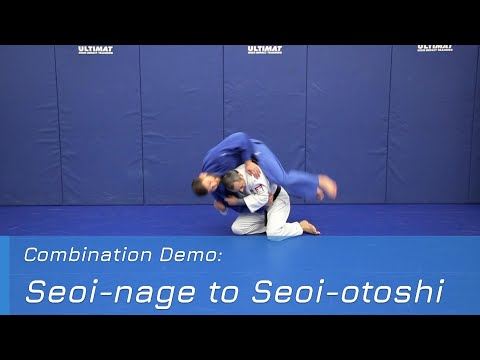
Follow up with