Quick Facts
- Category
- Katame-Waza
- Subcategory
- Kansetsu-Waza
- Difficulty
- Advanced
- Belt Level
- 1st kyu, 1st dan
Sankaku-Garami is an advanced arm entanglement technique that uses the legs in a triangular lock — similar to Sankaku-Jime — but targets the arm for a joint lock rather than choking the neck. The legs form a triangle that traps uke's arm (typically at the elbow), and the combined leg force and body mechanics create an armlock by bending the arm against its natural direction. It is closely related to Sankaku-Jime and often transitions between the two.
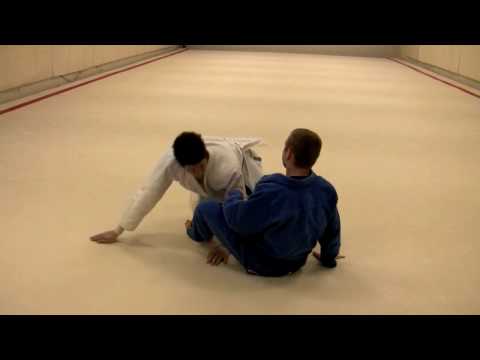
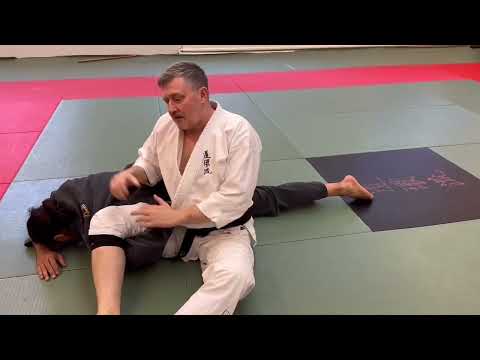
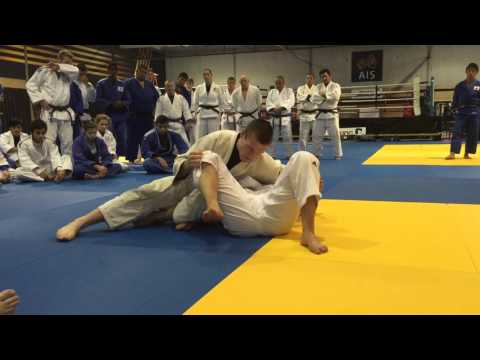
Sankaku-Garami — Step by Step
- 1
Control uke's arm and position legs
Gain control of one of uke's arms. Position your legs to form a triangle around the arm — one leg over the arm, the other hooking behind the first knee.
- 2
Form the triangle around the arm
Lock the triangular leg position around uke's arm at the elbow — similar to Sankaku-Jime's leg lock but targeted at the arm rather than the neck.
- 3
Trap the arm within the triangle
The arm is inside the triangular leg lock. Squeeze the legs to tighten the entanglement around uke's arm.
- 4
Apply mechanical force to the elbow
Rotate the hips or adjust body position to apply bending force on the trapped elbow joint. The leg triangle provides the frame; the hip mechanics provide the pressure.
- 5
Maintain until submission
Apply consistent pressure on the elbow joint. Uke taps when the joint pressure reaches the submission point.
What Makes It Work
- The triangular leg lock structure is identical to Sankaku-Jime but targets the arm, not the neck. Understanding Sankaku-Jime helps with Sankaku-Garami.
- Hip mechanics provide the joint-locking force. The legs trap and frame the arm; the hips generate the bending pressure.
- Sankaku-Garami and Sankaku-Jime are closely related — from the sankaku leg position, either can be applied depending on what uke's body presents.
- Arm positioning within the triangle determines the direction of joint stress. Precise arm capture is required.
What to Avoid
Triangle formed incorrectly — too loose or wrong part of arm
The triangle must lock around the arm at or near the elbow. Too loose and the arm can slip through; too far up the arm is ineffective.
No hip involvement — relying only on leg squeeze
The hips must engage to drive the joint-locking force. Leg squeezing alone is insufficient — hip rotation or elevation provides the leveraged pressure.
Confusing with Sankaku-Jime during execution
Know whether you are targeting the neck (Sankaku-Jime) or the arm (Sankaku-Garami) before committing. The leg lock structure is similar but the target and finishing mechanics differ.
Allowing uke to rotate the arm and escape
Keep tight control of the arm's rotation. Uke escaping by rotating the forearm means the entanglement needs to be tighter.
Best Moments to Apply Sankaku-Garami
Sankaku-Garami is applied from the sankaku leg-lock position when uke's arm is accessible rather than their neck, or when transitioning from a failed Sankaku-Jime. It is a high-level technique requiring extensive newaza experience.