Quick Facts
- Category
- Katame-Waza
- Subcategory
- Shime-Waza
- Difficulty
- Beginner
- Belt Level
- 5th kyu, 4th kyu
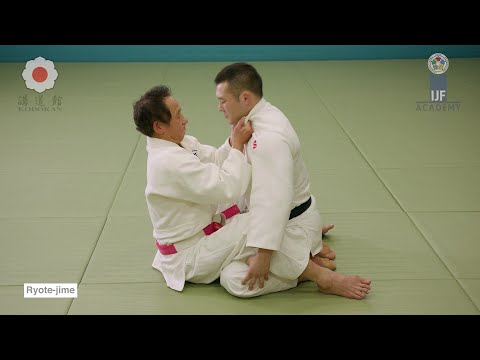
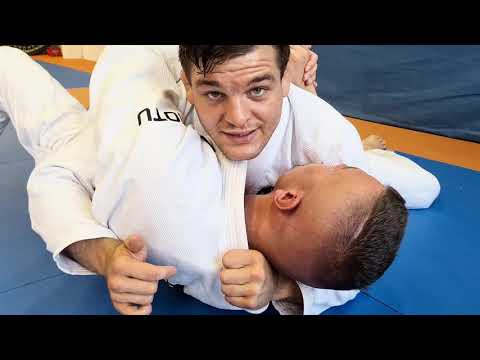
Ryo-Te-Jime is one of the simplest strangling techniques — tori uses both hands directly around uke's neck to apply a choke. "Ryo-te" means both hands. While straightforward in concept, effective application requires proper thumb and finger placement to compress the carotid arteries rather than the trachea. It is an introductory shime-waza technique.
Ryo-Te-Jime — Step by Step
- 1
Establish a top control position
Be in mount, kesa-gatame, or any position where your hands can reach both sides of uke's neck.
- 2
Place both hands on the neck
Bring both hands to uke's neck. Fingers are on the back or sides of the neck; thumbs are positioned at the front and sides of the neck.
- 3
Position thumbs on carotid arteries
Press the thumbs inward on the sides of the neck, targeting the carotid arteries. The goal is to compress the blood supply to the brain, not to squeeze the trachea.
- 4
Apply simultaneous bilateral pressure
Both thumbs press inward and upward simultaneously. Both hands work together to create a bilateral carotid compression.
- 5
Maintain position and apply consistent pressure
Hold the pressure consistently. Do not pulse or pump — steady compression is more effective and less exhausting.
What Makes It Work
- Both hands must work together — simultaneous bilateral carotid compression is the mechanism.
- Thumbs target the carotid arteries on the sides of the neck, not the trachea in the front. Trachea pressure is illegal and dangerous.
- Ryo-Te-Jime teaches the fundamental principle of all carotid-based strangling techniques.
- An effective position with good posture is required — hunched over with weak arms reduces pressure significantly.
What to Avoid
Pressing on the trachea with the thumbs
Move the thumbs to the sides of the neck. The carotid arteries are at the sides, not the front. Tracheal pressure is dangerous and illegal in competition.
Only using one hand effectively
Both hands must apply equal pressure. An asymmetric choke compresses one carotid but allows the other to supply blood, making the choke ineffective.
Poor control position — uke can push tori away
Establish solid control before applying the choke. From a weak position, uke can simply push your arms away.
Applying with straight, extended arms
Bend the elbows and drive body weight through the arms. Straight arms lock out and reduce effective pressure.
Best Moments to Apply Ryo-Te-Jime
Ryo-Te-Jime is applied from a mounted or top control position when both hands are free to reach the neck. It is a fundamental technique for beginners to develop the principle of bilateral carotid compression. In advanced practice, more sophisticated chokes are usually preferred, but Ryo-Te-Jime remains valid.