Quick Facts
- Category
- Nage-Waza
- Subcategory
- Te-Waza
- Difficulty
- Advanced
- Belt Level
- 1st kyu, 1st dan
Obi-Otoshi is an advanced te-waza where tori grips uke's belt and uses that grip — combined with a body drop or leg action — to project uke to the mat. The belt grip gives exceptional control over uke's hips and center of mass, but establishing the grip requires overcoming uke's defensive reactions. It is a rare technique seen primarily in kata and advanced randori.
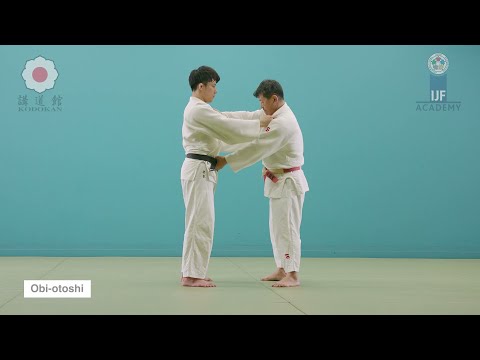
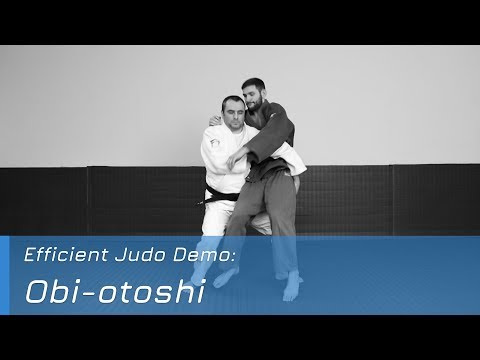
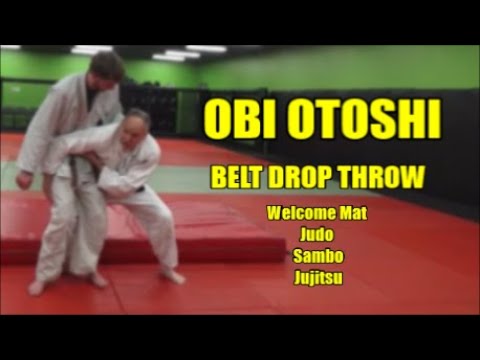
Obi-Otoshi — Step by Step
Kuzushi is created through the belt grip itself — pulling uke's hips sharply forward and upward breaks their balance to the front. Combined with a simultaneous pulling action on the sleeve or collar, uke is driven onto their toes and forward. The belt grip positions tori's pulling force directly at uke's center of mass.
Secure the belt grip — typically with the dominant hand reaching under and around to grip the back of uke's belt, or gripping the belt at the side. The other hand maintains collar or sleeve control. Entry involves lowering the body and positioning the hips or leg to serve as a fulcrum or blocking point.
Drive the belt grip upward and forward, simultaneously pulling the collar grip to create rotation. If using a leg or hip as a fulcrum, the combination of belt drive and blocking lever projects uke over. The throw can be completed as a hip-type throw using the belt grip as the key control, or as a pure hand technique driving uke forward.
- 1
Establish belt grip
Reach around uke to grip the back or side of uke's belt firmly. The grip should be deep — as close to the knot as possible for maximum control.
- 2
Create forward kuzushi
Pull the belt grip upward and forward, simultaneously using your other grip to destabilize uke's upper body. Uke's hips tip forward.
- 3
Position the throwing fulcrum
Step in or position your hip or thigh as a blocking point against uke's body. The belt-grip side of your body provides the lever.
- 4
Drive the belt and pull simultaneously
Pull the belt sharply upward and forward while driving your body rotation. The free arm controls uke's upper body direction.
- 5
Project to the mat
Uke's hips are pulled over the fulcrum point and they land on the mat in front of or beside tori.
What Makes It Work
- The belt grip is only as effective as its depth — a shallow grip on the edge of the belt can slip. Grip deeply as close to the knot as possible.
- The belt grip bypasses uke's sleeve and lapel defenses, acting directly on the center of mass. This is its primary advantage.
- Obi-Otoshi requires excellent timing and proximity — establishing the belt grip takes time, so it is often applied after a prior technique creates the opening.
- As an advanced technique, it benefits from mastery of hip throw mechanics, as the belt-grip entry shares principles with koshi-waza.
What to Avoid
Gripping the edge of the belt — grip slips
Reach deeply around uke and grip as close to the belt knot as possible. A secure, deep grip is the foundation of the technique.
No secondary grip control
Always use the free hand for collar or sleeve control. The belt grip alone without secondary control allows uke to post out and escape.
Attempting Obi-Otoshi without sufficient proximity
You must be very close to uke to establish the belt grip. Use gripping exchanges or combination attacks to close the distance first.
Pulling the belt sideways instead of upward and forward
The belt pull must be upward and toward uke's front. A sideways pull simply rotates them without lifting off their base.
Best Moments to Apply Obi-Otoshi
Obi-Otoshi is most practical when uke's grip defenses focus on the lapel and sleeve, leaving the belt accessible. It is used by experienced practitioners in randori as a surprise element or as a kata demonstration technique. It is rarely seen at competition level due to the time required to establish the belt grip, but it is a valuable element of advanced judo curriculum.
Combination Sequences
Attack these first