Quick Facts
- Category
- Nage-Waza
- Subcategory
- Te-Waza
- Difficulty
- Beginner
- Belt Level
- 6th kyu, 5th kyu, 4th kyu
O-Soto-Otoshi is a major outer dropping throw closely related to Osoto-Gari. Where Osoto-Gari reaps the leg with a pendulum swing, O-Soto-Otoshi drops uke directly backward by blocking the outside of their leg and using body weight to push them over and down. The "otoshi" (drop) component means tori drives their body weight directly downward onto uke rather than reaping. This makes O-Soto-Otoshi more accessible for beginners as it relies on body weight rather than sweeping leg power.
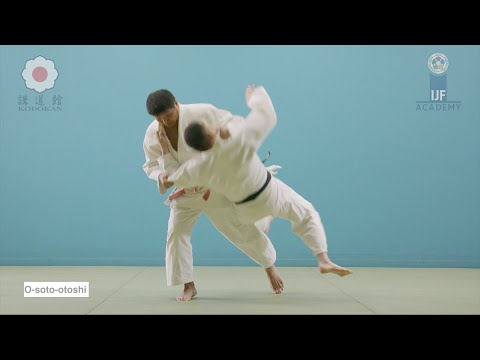
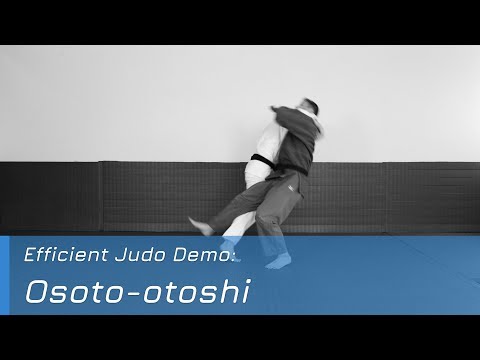
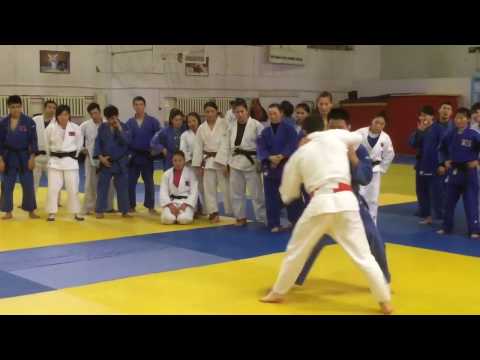
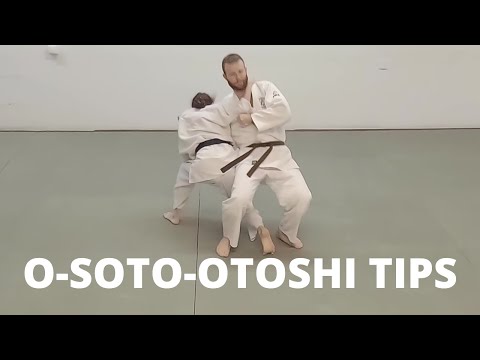
O-Soto-Otoshi — Step by Step
Step to uke's right side and pull their sleeve arm forward and upward while pushing the lapel arm over and to uke's right rear corner. Uke's weight should shift onto their right heel as they are pulled and pushed backward and to their right.
Step your right foot to the outside of uke's right foot, placing it behind and to the outer side. Move your chest close to uke's chest. Your right leg is now outside uke's right leg. Begin to lean your upper body forward and into uke's upper body, driving their weight backward onto their right heel.
Push uke's upper body backward and down while simultaneously pressing your right leg against the back of uke's right thigh, blocking their leg from stepping backward to recover. Drop your own body weight forward and onto uke, driving them straight down and backward to the mat. The dropping body weight does the primary work.
- 1
Step to the outside
Step your right foot to the outside of uke's right foot, positioning your body to uke's right side with your chest facing theirs.
- 2
Break uke's balance backward
Pull uke's sleeve arm upward and forward while driving the lapel arm across uke's body toward their right rear. Shift their weight onto their right heel.
- 3
Press your body against uke
Drive your chest into uke's chest, leaning forward. Maintain the backward push with your arms while physically pressing uke backward with your torso.
- 4
Block uke's retreating leg
Place your right leg against the back of uke's right thigh. This blocks uke from stepping backward to recover balance.
- 5
Drop uke backward
Drive your body weight forward and downward, pushing uke over the blocked leg. Uke drops straight backward to the mat.
What Makes It Work
- The "drop" is driven by body weight — lean your chest into uke and use gravity, not just arm strength.
- The leg block prevents uke stepping backward; without it, uke simply retreats and the throw fails.
- Break uke's balance to their right rear before entering — a balanced uke can absorb the forward push.
- Stay tight to uke throughout; any distance between chests reduces the pressure needed to drop them.
What to Avoid
Trying to reap the leg like Osoto-Gari
O-Soto-Otoshi is a drop, not a reap. The leg blocks uke's thigh and the body weight drives downward — there is no pendulum reap.
Standing too far from uke during the drop
Your chest should be pressed against uke's chest. Distance reduces the forward-dropping pressure on uke.
Blocking too low (knee or ankle instead of thigh)
The block should be against uke's upper thigh. Blocking at the knee puts torque on the joint; at the ankle, uke can step over it.
Not establishing backward kuzushi first
Uke must be pushed backward before the drop. A forward-balanced uke will simply push you back.
Best Moments to Apply O-Soto-Otoshi
O-Soto-Otoshi is effective as a direct attack when uke is backing away or has been pushed backward. It works well in combination with forward-attacking throws — if uke resists a forward throw and pushes back, transitioning immediately to O-Soto-Otoshi exploits their backward momentum. It is also effective as a counter to uke stepping in for a hip throw.
Combination Sequences
Follow up with