Quick Facts
- Category
- Katame-Waza
- Subcategory
- Shime-Waza
- Difficulty
- Intermediate
- Belt Level
- 3rd kyu, 2nd kyu
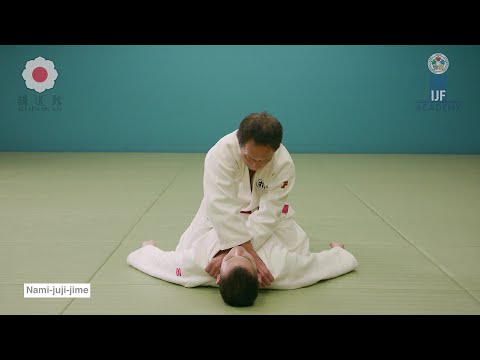
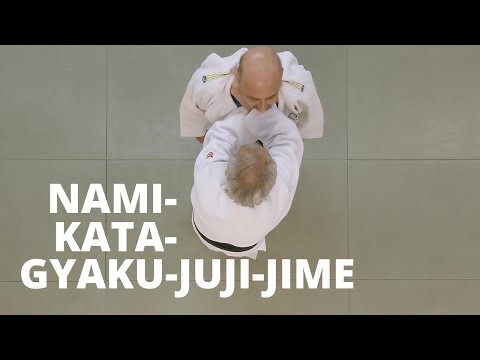
Nami-Juji-Jime is the standard cross-lapel choke applied from mount or a guard position. Both hands grip the opposite collars, and the forearms cross at uke's throat to compress the carotids. Together with Gyaku-Juji-Jime (reverse cross choke) and Kata-Juji-Jime (half cross choke), it forms the fundamental Juji-Jime family. It is heavily used in BJJ as "cross collar choke."

Nami-Juji-Jime — Step by Step
- 1
Establish mount or control position
Nami-Juji-Jime is most commonly applied from mount (tori sitting on uke's chest) or from a guard-pass position.
- 2
Insert your right hand deeply into uke's left collar
Slide your right hand palm-up deep into uke's left collar. Your four fingers are inside the collar, thumb outside. This hand will become the primary choke arm.
- 3
Insert your left hand into uke's right collar
Cross your left arm over your right arm and insert your left hand into uke's right collar. This is the "cross" — both arms are now crossing in front of uke's throat.
- 4
Close the choke by squeezing elbows together
Pull your elbows down and together. This drives your forearms (and the crossing collar material) into both sides of uke's neck, compressing the carotids.
- 5
Apply final pressure
Lean your body weight forward to increase the choke pressure. The crossing forearms compress uke's carotid arteries on both sides simultaneously.
What Makes It Work
- Palm-up grip on the first hand allows the forearm to contact the carotid more effectively.
- The deeper the collar grip, the more leverage and carotid contact you have.
- Both arms cross at the wrist/forearm — the crossing point should be at uke's throat.
- Squeezing the elbows inward (not just the hands) creates the maximum choking pressure.
What to Avoid
Shallow collar grip
Drive your hand as deep as possible into the collar. Shallow grip reduces the forearm contact on the carotid.
Pulling outward instead of squeezing elbows inward
The pressure comes from driving the elbows down and together. Pulling the hands outward just stretches the collar without compressing the neck.
Pressure on the windpipe, not the carotids
The forearms should contact the sides of the neck, not the front. Adjust your hand position so you feel carotid contact.
Best Moments to Apply Nami-Juji-Jime
Nami-Juji-Jime is most commonly applied from mount or after passing the guard. It is a first-choice choke when you have both collars available. Pairs with Gyaku-Juji-Jime — if uke defends one collar, switch grip to the other variant.