
Quick Facts
- Category
- Katame-Waza
- Subcategory
- Osaekomi-Waza
- Difficulty
- Beginner
- Belt Level
- 6th kyu, 5th kyu
Makura-Kesa-Gatame is a variation of Kesa-Gatame where instead of gripping uke's collar, tori uses their arm as a "pillow" (makura) under uke's neck — cradling uke's head with one arm while the other traps uke's arm. It is a comfortable, stable hold that is excellent for beginners and provides good control while being slightly less exposed to certain escapes than standard Kesa-Gatame.
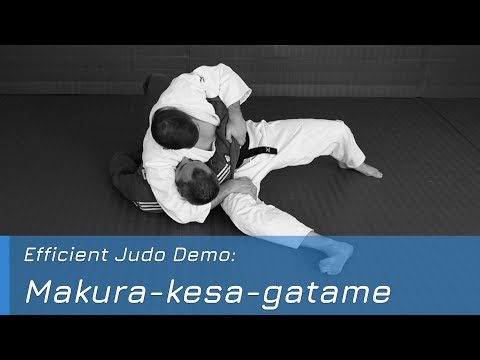
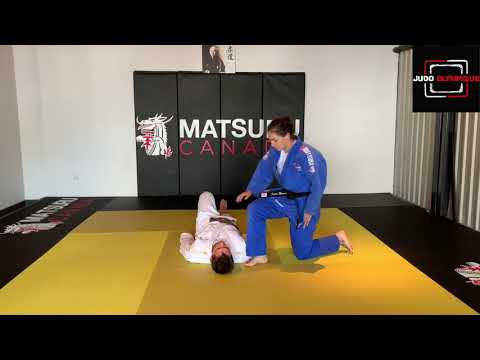
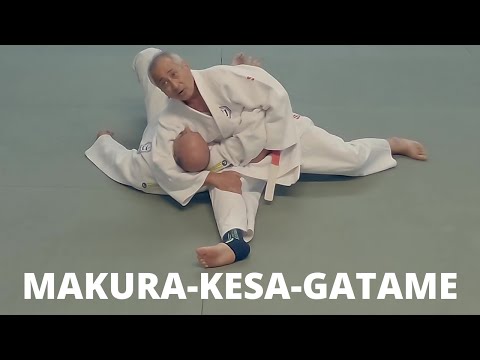
Makura-Kesa-Gatame — Step by Step
- 1
Position at uke's right shoulder
Sit beside uke at their right shoulder, facing toward their feet — same positioning as Kesa-Gatame.
- 2
Trap uke's right arm under your left armpit
Wrap your left arm under and around uke's right arm, trapping it tightly in your armpit. This is identical to standard Kesa-Gatame.
- 3
Slide your right arm under uke's neck
Rather than gripping uke's collar, slide your right forearm under uke's neck so that uke's head rests on your arm like a pillow (makura). Your arm is the cradle.
- 4
Cradle the head with your right arm
Your right arm supports uke's head — the forearm acts as the pillow. This head cradle provides additional control over uke's head and neck movement.
- 5
Spread legs and apply weight
Spread your legs for a stable base. Drive your weight into uke's chest and shoulder. The head cradle prevents uke from bridging toward your head.
What Makes It Work
- The "pillow" arm under uke's neck controls their head — where the head goes, the body follows. Head control prevents many escape attempts.
- The trapped arm mechanics are identical to Kesa-Gatame. The distinction is only in the neck/head control arm.
- Body weight remains the primary holding force — spread your legs and press your weight onto uke.
- Makura-Kesa-Gatame is a natural first variation to teach after standard Kesa-Gatame, as the mechanics are almost identical.
What to Avoid
Arm too far under uke's neck — pressure on throat
The arm should be under the neck, not pressing on the throat. Adjust to cradle the back of the neck, not the front.
Losing the arm trap while focusing on the head cradle
Both elements must be maintained simultaneously. The arm trap and the pillow grip both need to be secure.
Sitting upright — high center of gravity
Lean your weight forward and down onto uke's chest. A high position is easily escaped.
Legs too close together
Spread legs wide for stability. Narrow leg position is vulnerable to rolling escapes.
Best Moments to Apply Makura-Kesa-Gatame
Makura-Kesa-Gatame is the natural hold-down from throws that project uke beside tori — Osoto-Gari, Ko-Soto-Gari, Ko-Soto-Gake. The pillow arm variation provides better head control than standard Kesa-Gatame, making it preferred when uke is trying to bridge toward tori's head.