Quick Facts
- Category
- Nage-Waza
- Subcategory
- Te-Waza
- Difficulty
- Intermediate
- Belt Level
- 3rd kyu, 2nd kyu
Kibisu-Gaeshi is a heel pick throw where tori seizes uke's heel and lifts it sharply upward while simultaneously pushing uke's upper body backward, dumping them to the mat. It is often used as a counter-technique or in combination when uke retreats or moves backward, and it exemplifies the te-waza principle of using the hands alone — without hip or leg contact — to execute a throw.
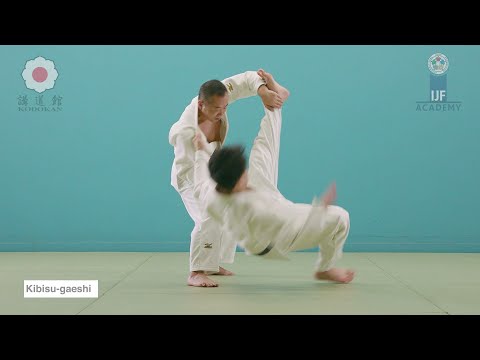
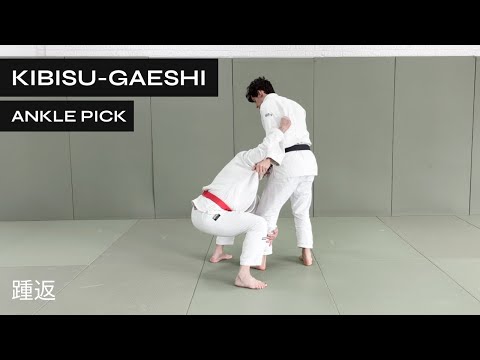

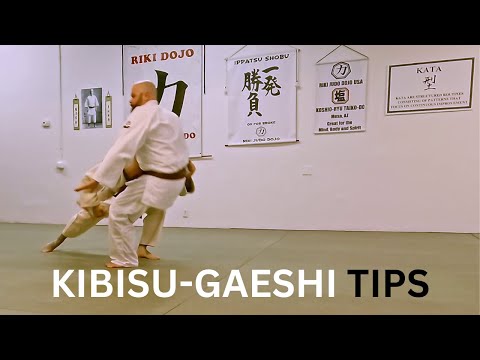
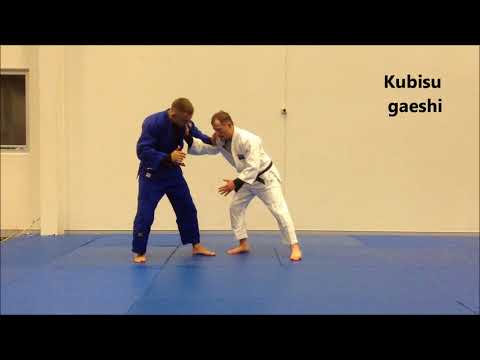
Kibisu-Gaeshi — Step by Step
Uke's balance is broken to their rear. This is typically achieved by pushing uke's upper body backward with one hand on the chest or collar, while simultaneously seizing their heel. The backward push and the heel lift create opposing forces that collapse uke's base from underneath.
Lower your body by bending at the knees and hips. Reach down with one hand to grip uke's heel from behind or the side — the grip wraps around the heel, fingers under the Achilles tendon. Your other hand simultaneously grips uke's collar or lapel at chest height for the push.
Lift the heel sharply upward while driving uke's upper body backward with the collar push. The simultaneous actions of lifting the foot and pushing the chest create an immediate and dramatic loss of balance. Uke falls backward onto the mat.
- 1
Create or identify rearward movement
Kibisu-Gaeshi works when uke steps backward or is being pushed backward. Create the opportunity by pushing uke's chest or by following uke's retreat.
- 2
Lower your level
Bend your knees and drop your hips to bring your hand to heel height. Stay close to uke as you lower down.
- 3
Grip the heel
Reach down and grip uke's near heel firmly — fingers curling around the back of the heel under the Achilles tendon. The grip must be secure.
- 4
Grip the collar or chest with the free hand
Simultaneously grip uke's lapel near the collar with your other hand for the backward push.
- 5
Lift and push simultaneously
Drive the heel upward sharply while pushing uke's upper body backward. These two forces destroy uke's base and send them straight onto their back.
What Makes It Work
- Both actions — heel lift and upper-body push — must happen simultaneously. Sequential execution gives uke time to adjust.
- Stay close to uke when gripping the heel. Reaching too far extends your back and reduces lifting power.
- The heel grip should be firm and wrap under the Achilles tendon. A grip on the toe or ankle is weaker and easier for uke to pull free.
- Kibisu-Gaeshi often arises from uke's retreating movement — learn to read when uke is stepping back and time the technique to coincide with their weight shift.
What to Avoid
Pushing first, then lifting the heel
The push and lift must be simultaneous. If you push first, uke hops backward. If you lift first, uke leans forward. The simultaneous action is what traps them.
Gripping the toe or lower ankle
Grip the heel — wrap your fingers under the Achilles tendon. A toe or ankle grip has poor leverage and uke can simply pull their foot free.
Standing too far from uke when reaching for the heel
Move in close before dropping to heel height. Reaching from a distance rounds your back and removes power from the lift.
Attempting Kibisu-Gaeshi against a stationary uke
The technique is most effective when uke is moving or off-balance. Against a planted, upright uke, the heel is hard to grip and easier to defend.
Best Moments to Apply Kibisu-Gaeshi
Kibisu-Gaeshi is most effective as a counter when uke steps backward and briefly has weight on the back foot, making the heel accessible. It is also used in combination with forward attacks — when uke retreats to avoid a throw, tori switches to the heel pick. It is classified as te-waza because the throw is executed entirely with the hands.