Quick Facts
- Category
- Katame-Waza
- Subcategory
- Shime-Waza
- Difficulty
- Intermediate
- Belt Level
- 3rd kyu, 2nd kyu
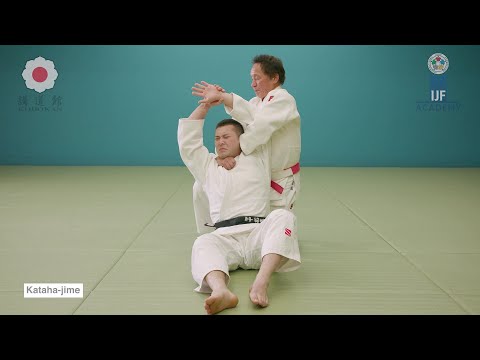
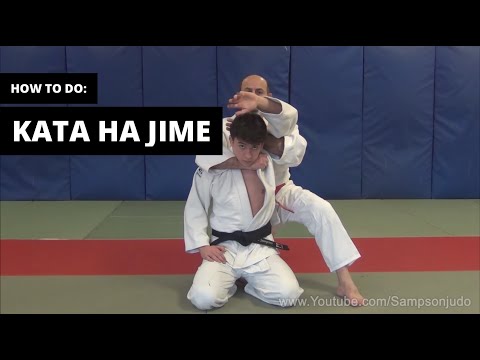
Kataha-Jime is a powerful strangle applied from behind uke that combines a choking arm around the neck with an arm that traps one of uke's arms up behind their back. The "single wing" (kataha) refers to the one arm of uke that is trapped — bent up behind their head like a bird's folded wing. This dual control of the neck and an arm makes it both a choke and an arm control technique.
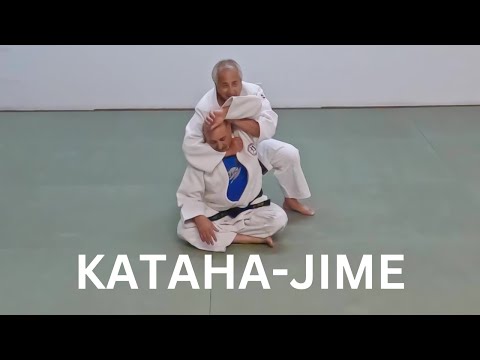
Kataha-Jime — Step by Step
- 1
Establish rear control
Get behind uke — on their back or in a rear control position with uke sitting or lying.
- 2
Apply the choking arm
Slide one arm under uke's chin and around their neck. The forearm or upper arm contacts the carotid arteries at the sides of the neck.
- 3
Trap uke's near arm
With your free hand, reach over uke's shoulder and grab their near arm (the arm on the same side as your choking arm). Bend their arm up behind their neck.
- 4
The "wing" position
Uke's arm is bent with their elbow pointing up behind their head — like a bird's folded wing. This position traps the arm and prevents them from defending the choke.
- 5
Apply the strangle
Squeeze the choking arm into the neck while maintaining the arm trap. The combination of the choke and the trapped arm prevents most escape attempts.
What Makes It Work
- The arm trap is what distinguishes Kataha-Jime from other rear chokes — it removes one defense arm while applying the strangle.
- The choking arm contacts the sides of the neck (carotid arteries), not the throat. Tracheal pressure is both ineffective and dangerous.
- Once the wing position is achieved, uke has very limited options. The trapped arm prevents any reach-back defense.
- Body positioning behind uke must be secure. If uke can create space, they can roll to escape.
What to Avoid
Choking at the throat instead of the sides of the neck
Aim for the carotid compression — sides of the neck. Trachea chokes are illegal and ineffective in competition.
Not completing the arm trap — wing not secured
Ensure uke's arm is fully bent up behind their head. A partial trap allows uke to free the arm and defend.
Losing rear control — uke rolls to face you
Maintain rear body control with your legs or by hooking uke's body. If uke faces you, the strangle position is lost.
Applying too much arm muscle — not using technique
The choke works by compressing the carotids, not by brute arm strength. Proper alignment is more important than pure force.
Best Moments to Apply Kataha-Jime
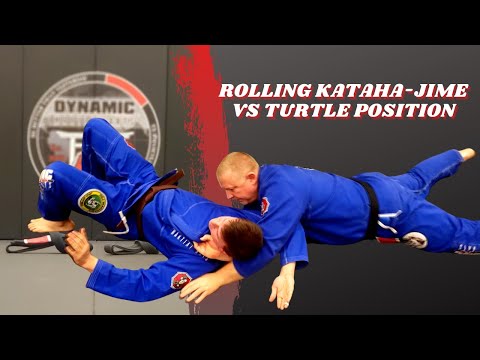
Kataha-Jime is used from the rear control position — after a takedown or throw that ends with tori behind uke, or after uke rolls in newaza and exposes their back. It is particularly effective because it simultaneously attacks the neck and immobilizes one arm.