Quick Facts
- Category
- Katame-Waza
- Subcategory
- Shime-Waza
- Difficulty
- Intermediate
- Belt Level
- 3rd kyu, 2nd kyu
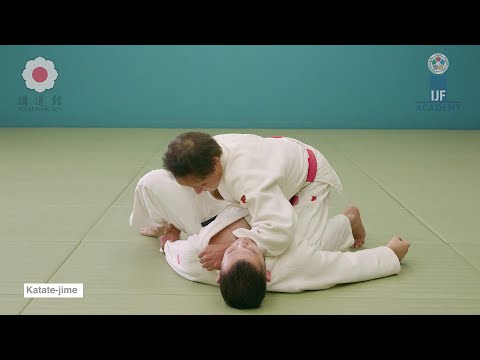
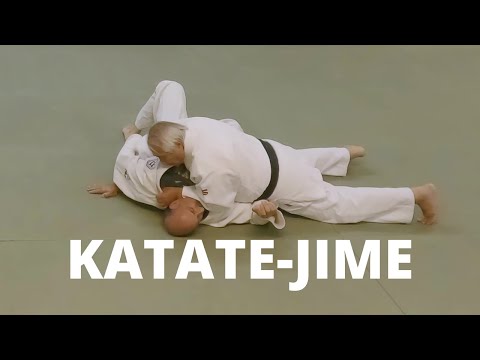
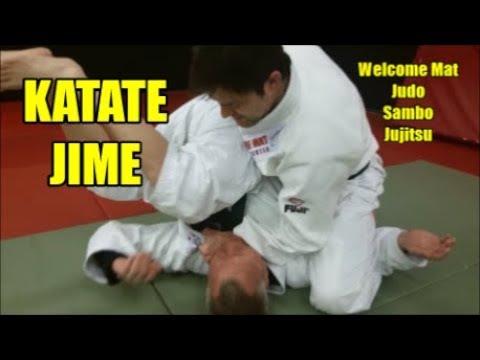
Kata-Te-Jime is a one-handed collar choke in which a single hand reaches across uke's collar — gripping deep on the opposite lapel — to compress the carotid artery on one side of the neck. The free hand is used to control uke's posture by gripping the arm, head, or same-side lapel, and may also contribute pressure from the opposite side. Part of the official Kodokan shime-waza (strangulation technique) classification, Kata-Te-Jime is applied from positions of upper-body control such as kesa-gatame, yoko-shiho position, or the mount.
Kata-Te-Jime — Step by Step
In ne-waza shime-waza, the traditional kuzushi concept does not directly apply. Control is established by securing a dominant top position — typically a hold-down variant — before applying the strangle. Body weight and positional pressure replace kuzushi: tori's mass on top of uke prevents escape and forces the neck into the choke.
From a controlling top position (kesa-gatame, side control, or mount), reach the choking hand across uke's throat to grip the far collar as deeply as possible, with the palm facing downward. The thumb may enter from the outside or inside of the collar depending on the grip variation used. Your body weight presses down onto uke throughout the grip establishment.
Once the cross-collar grip is secured, pull inward and rotate your wrist so the blade edge of the forearm or wrist compresses the near carotid artery against the side of uke's neck. Simultaneously use the free hand — gripping uke's arm, head, or same-side lapel — to prevent uke from bridging and to maintain chest-to-chest (or chest-to-back) body weight pressure. The strangle effect is carotid compression on the gripped side.
- 1
Establish a dominant top position
Secure a controlling ground position — kesa-gatame, yoko-shiho, or mount — before attempting the choke. An insecure position allows uke to escape before the choke develops.
- 2
Reach the choking hand across uke's throat
Reach your choking hand across uke's neck and grip the far collar as deeply as possible — four fingers inside the collar, palm down. The deeper the grip, the more effective the compression.
- 3
Position the wrist against the near carotid
Rotate the choking wrist so the blade of the forearm or wrist presses against the near side of uke's neck, loading the carotid artery.
- 4
Use the free hand to control and add pressure
Grip uke's arm, same-side collar, or place the free hand on uke's head to control posture and prevent bridging. Some variations use the free hand to compress the opposite carotid from the other side.
- 5
Apply compression with inward pull and weight
Pull the choking hand inward toward your own chest while pressing your body weight down. The combined inward pull, wrist rotation, and top-position weight create the carotid compression.
What Makes It Work
- Depth of the collar grip is critical — a shallow grip compresses the windpipe (painful but slow); a deep grip compresses the carotid arteries (effective and rapid).
- The choke works on the near-side carotid. The cross-collar grip pulls the collar fabric across the neck while the forearm or wrist edge presses from the near side.
- Top-position body weight is a multiplier. The compression from one hand is amplified by tori's full weight pressing down.
- Control the free hand actively — it prevents uke from turning into or bridging out of the choke while it is being set.
- Do not rely on windpipe pressure. Kata-Te-Jime, like all Kodokan shime-waza, is effective through carotid artery compression.
What to Avoid
Shallow collar grip compressing only the windpipe
Drive the gripping hand deeper into the collar until the knuckles contact the back of uke's neck. Shallow grips are painful but not efficient strangles.
Losing top-position control while gripping
Establish and maintain the top hold before reaching for the collar. Attempting the grip from an unstable position allows uke to turn and escape.
Free hand idle — uke bridges out of the choke
Use the free hand actively to control uke's arm or apply additional pressure. An idle free hand removes half the choke's security.
Pulling the collar outward instead of inward
Pull the choking hand inward toward your chest — this drives the collar fabric deeper across the neck and increases carotid pressure.
Best Moments to Apply Kata-Te-Jime
Kata-Te-Jime is most applicable when you control uke's upper body from a top position and uke's collar is accessible but a two-handed choke grip (such as Okuri-Eri-Jime) is not immediately available. It is also a useful transitional choke when uke is defending one arm from a choke attempt — the single-hand cross-collar grip can be established with one arm while the other continues to control.