Quick Facts
- Category
- Katame-Waza
- Subcategory
- Shime-Waza
- Difficulty
- Intermediate
- Belt Level
- 3rd kyu, 2nd kyu, 1st kyu
Kata-Juji-Jime is a cross-collar choke that uses a mixed grip — one hand with the thumb inside the collar and one hand with the fingers inside the collar. "Kata" means "half" or "one-sided," referring to this hybrid grip orientation. One arm pulls the collar edge into the carotid on one side while the other pushes the collar edge from the other side, creating a scissors-like compression. Kata-Juji-Jime is considered a middle-ground technique between Nami-Juji-Jime and Gyaku-Juji-Jime, combining elements of both.
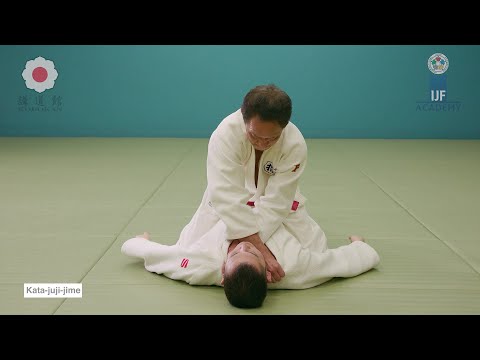
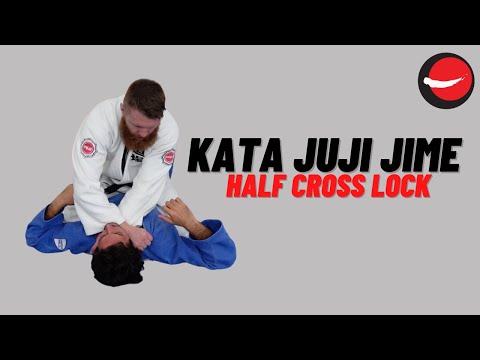
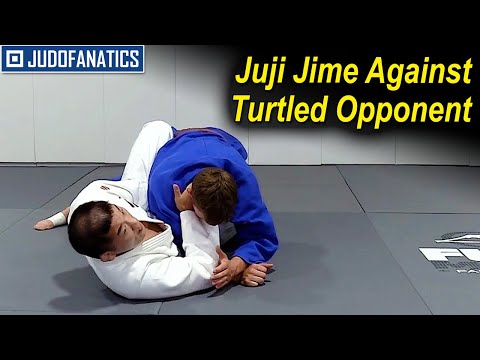
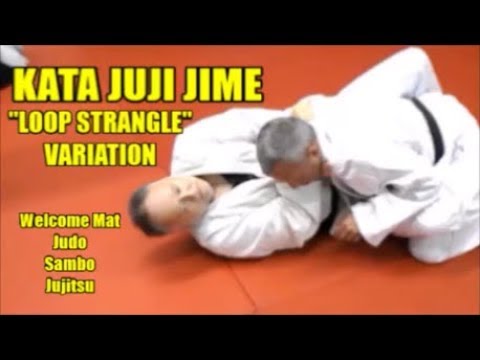
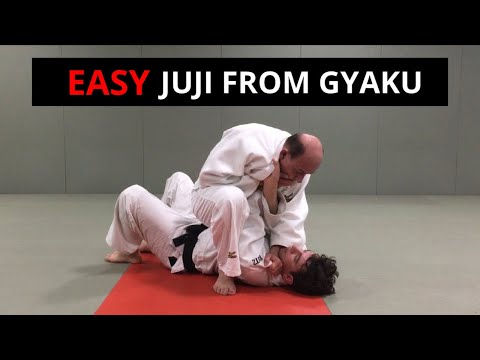
Kata-Juji-Jime — Step by Step
From a top or mounted position, maintain chest contact with uke and keep their upper body controlled. Open the collar with the thumb-grip hand first to establish the deeper grip. Uke's head should be relatively flat on the mat to allow clear collar access.
Insert your right thumb inside uke's left collar, pulling it toward the side of uke's neck (as in Gyaku-Juji-Jime). Then insert your left hand with fingers inside uke's right collar, thumb outside (as in Nami-Juji-Jime). Your arms cross at the wrists — the thumb-in arm goes deeper, the fingers-in arm crosses over.
With the mixed grip established, apply the choke by pulling the thumb-in hand backward (driving collar edge into carotid) while pushing the fingers-in hand forward (scissors action). The dual action compresses both sides of the neck. Drive your chest forward to add body weight to the compression.
- 1
Secure top position and access collar
Establish a top position (mount or modified side control) and widen uke's collar if necessary.
- 2
Insert thumb-in grip (deep hand)
Insert your right thumb inside uke's left collar as deep as possible, directing it toward the back of the neck. This is the thumb-in grip.
- 3
Insert fingers-in grip (near hand)
Cross your left arm over your right and insert fingers inside uke's right collar. This is the fingers-in grip — fingers inside, thumb outside the collar.
- 4
Apply scissors compression
Pull the thumb-in arm backward while pushing the fingers-in arm forward. The scissors action drives both collar edges into uke's carotid arteries.
- 5
Add chest pressure
Lower your chest onto uke and maintain the pulling-pushing scissors action. Sustain until submission.
What Makes It Work
- The mixed grip (one thumb-in, one fingers-in) creates a scissors action — one hand pulls while the other pushes.
- The thumb-in hand goes deeper and should be placed first for maximum collar depth.
- The scissors mechanism compresses both carotids simultaneously, making this an efficient bilateral choke.
- Chest contact amplifies the choking force — a purely arm-based choke is weaker.
What to Avoid
Both hands using the same grip orientation
Kata-Juji-Jime requires one thumb-in and one fingers-in grip. If both are the same, it becomes Gyaku or Nami, losing the scissors advantage.
Shallow collar grips on either hand
Both grips must penetrate deep into the collar. Shallow grips rest on the front of the neck (trachea) rather than the sides (carotids).
Pulling both hands in the same direction
The scissors action requires one hand to pull and one to push in opposite directions. Same-direction pulling reduces bilateral compression.
No body weight applied
Body weight is a multiplier. Drive your chest toward uke to add body pressure to the choke mechanics.
Best Moments to Apply Kata-Juji-Jime
Kata-Juji-Jime is particularly useful when uke's collar positioning makes a full Gyaku-Juji-Jime difficult — the hybrid grip provides flexibility. It works from mount, side control, and as a transition from other collar chokes when uke shifts their defence. It can also be applied when moving from guard to top position as uke tries to establish grips.