Quick Facts
- Category
- Nage-Waza
- Subcategory
- Te-Waza
- Difficulty
- Advanced
- Belt Level
- 2nd kyu, 1st kyu, 1st dan
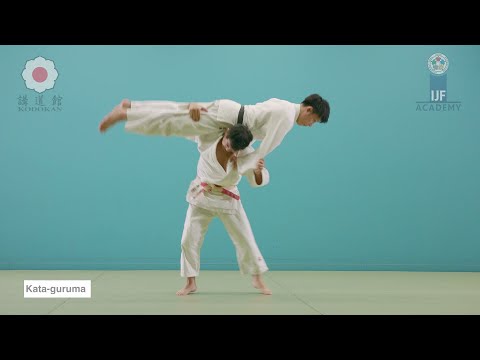
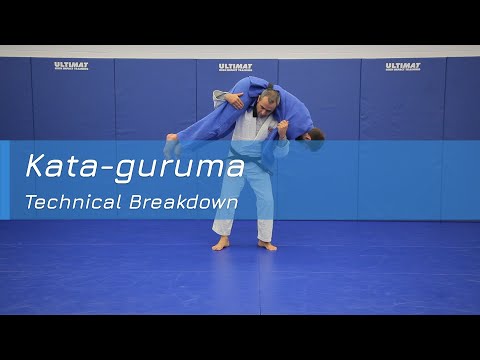
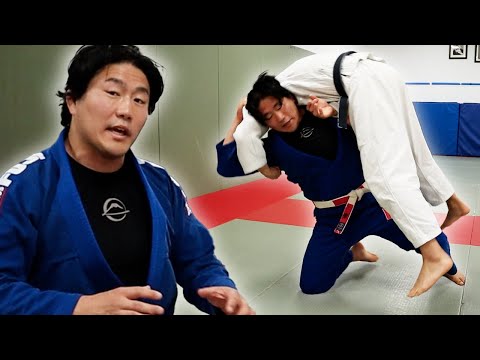
Kata-Guruma is a spectacular shoulder throw in which tori squats deeply, places uke across both shoulders, and then stands and rotates to wheel uke off to one side. Often called the "fireman's carry" of judo, it requires tori to drop very low under uke's centre of gravity, loading their entire body weight across the shoulders. It is a high-difficulty technique due to the deep squat entry and the vulnerability it creates during execution. Modern competition versions often use a modified grip that avoids the full shoulder-load position.

Kata-Guruma — Step by Step
Pull uke's sleeve arm strongly forward and downward while driving your body low and forward under uke's centre of gravity. The kuzushi is downward and forward — you are not pulling uke to a corner but drawing their weight forward and down onto you as you drop beneath them.
Drop into a deep squat directly in front of uke, driving your right shoulder into uke's lower abdomen or hip region. Simultaneously reach your right arm to grip the back of uke's right thigh (classical form: between the legs; IJF competition form: from the outside of the leg). Your left arm continues holding uke's sleeve, pulling it downward. Your shoulder becomes the loading platform.
With uke loaded across your shoulders — right shoulder supporting their abdomen, right arm gripping their thigh, left arm controlling their sleeve — stand up and simultaneously rotate your body. As you rise, the rotation and the standing motion wheel uke over your shoulder and to the mat beside you.
- 1
Break balance downward and forward
Pull uke's sleeve strongly forward and downward. Begin to drop your own level rapidly, drawing uke's weight over and forward.
- 2
Drop into a deep squat under uke
Squat deeply, lowering your hips until your right shoulder is at uke's hip level. Drive your right shoulder into uke's lower abdomen.
- 3
Establish the loading grip
In the classical form, reach your right arm between uke's legs to grip the back of their right thigh (note: this between-the-legs grip is prohibited in IJF competition — see competition variation below). Your left arm maintains the sleeve. Uke's weight begins to load across your shoulders.
- 4
Complete the load
Ensure uke's torso lies across your upper back and both shoulders. Their hips are above your right shoulder, legs above your left.
- 5
Stand and wheel
Drive upward with your legs while rotating your upper body. Uke wheels over your right shoulder and is projected to the mat.
What Makes It Work
- The squat must be deep enough to get your shoulder under uke's centre of gravity — a shallow squat fails to load uke.
- The thigh grip with the right arm is essential for controlling uke's lower body during the wheel.
- The throwing power comes from the legs standing up — use your strongest muscles (quads, glutes) to generate the throw.
- Speed of entry is critical; a slow drop gives uke time to sprawl and defend.
What to Avoid
Insufficient depth of squat
You must get low enough that your shoulder is at uke's hip level. If you only partially squat, uke's weight is not loaded and the throw produces only a forward lean.
Losing the thigh grip during the throw
The right arm must maintain contact with uke's thigh throughout. Without it, uke's lower body drops and the wheel motion is incomplete.
Attempting the throw without committing to the drop
Kata-Guruma requires full commitment to the deep squat. A hesitant entry leaves you in a vulnerable crouched position that uke can exploit.
Rotating without standing first
Stand up first to generate the lifting force, then rotate. Pure rotation without the leg drive produces a weak throw.
Best Moments to Apply Kata-Guruma
Kata-Guruma is most effective against taller opponents — tori must drop deeply under uke's centre of gravity, which is more achievable when uke is taller. It is used as a surprise attack when uke commits hard to an upright defensive posture with their hips forward. In modern competition, it is often used via a modified grip when uke attempts a forward throw or drops to the ground.