Quick Facts
- Category
- Katame-Waza
- Subcategory
- Kansetsu-Waza
- Difficulty
- Intermediate
- Belt Level
- 3rd kyu, 2nd kyu
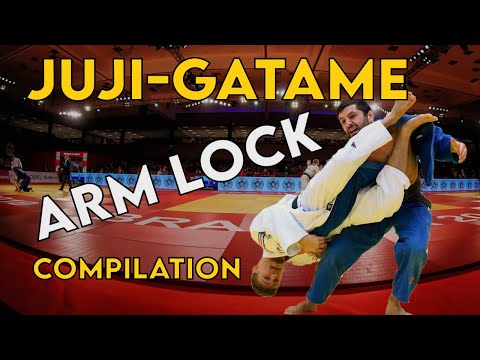
Juji-Gatame is the most well-known joint lock in judo and the foundational armlock of both judo and Brazilian Jiu-Jitsu. Tori hyperextends uke's elbow by placing uke's straightened arm across their own hips while pulling the wrist toward the mat. It can be applied from multiple positions — mount, side control, north-south. In IJF competition judo, guard-based applications are restricted; the most common entries are from side control, mount, and ura-kesa positions.
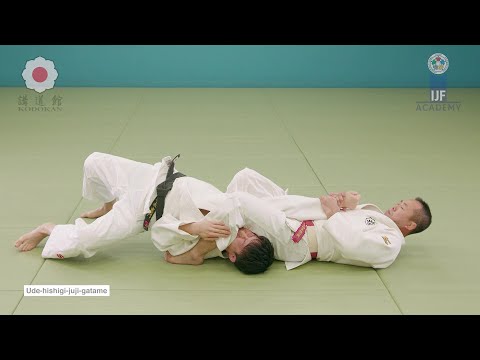
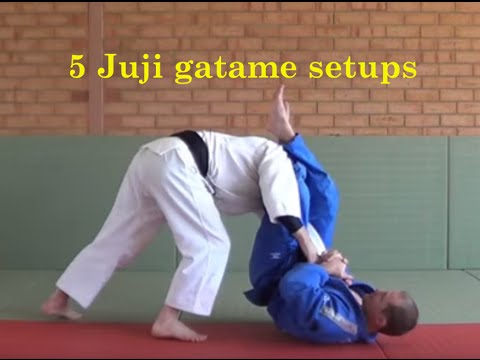
Juji-Gatame — Step by Step
- 1
Isolate and control uke's arm
Isolate uke's right arm so that it is straight and aligned perpendicular to their body. Control it with both your hands gripping near the wrist.
- 2
Sit perpendicular to uke at their right shoulder
Position yourself perpendicular to uke, with their arm between your thighs. Your right thigh is across their neck/shoulder; your left thigh is across their torso. Your right thigh pressing across uke's neck/shoulder prevents them from rolling into you to escape.
- 3
Clamp uke's arm between your thighs
Squeeze your thighs firmly around uke's arm to control it. Their elbow should be between your thighs pointing upward. The thumb of their controlled arm should point upward.
- 4
Hold uke's wrist against your chest
Pull uke's wrist to your chest with both hands. Their arm should be straight — not bent at the elbow.
- 5
Apply pressure by thrusting your hips upward
Drive your hips upward (bridge) while pulling the wrist downward toward the mat. This creates a hyperextension force on uke's elbow joint. Apply slowly and release immediately when uke taps.
What Makes It Work
- The elbow must point upward (thumb up on the trapped hand) — rotating the arm 90 degrees before applying pressure eliminates the elbow's natural range.
- Squeeze the thighs together firmly — any gap allows uke to pull their arm free.
- The hip thrust (bridge) is the primary force — pulling arms alone is less effective.
- Control the shoulder by placing your right thigh across it — this prevents uke from rolling into you.
- Apply force incrementally — Juji-Gatame is an immediate tap-or-break situation and must be controlled.
What to Avoid
Arm rotated incorrectly — thumb pointing down
Rotate uke's arm so their thumb points upward before extending. Thumb-down presents the bent elbow face, not the hyperextension face.
Gap between thighs — arm escapes
Squeeze your thighs together. Practice "pinching" with your knees throughout the lock.
Pulling the arm with hands only, no hip thrust
Bridge your hips upward while pulling the wrist down. The hip power is 10x the arm power.
Applying too quickly — risk of injury
Juji-Gatame must be applied with progressive pressure, giving uke time to tap. A fast, sudden application is a joint injury risk.
Best Moments to Apply Juji-Gatame
Juji-Gatame can be applied from mount, side control, north-south, or when uke leaves an arm exposed during ground transitions. In competition, the classic path is: secure side control or mount → isolate the near arm → roll into Juji-Gatame position → apply. Also common as a counter when uke reaches for a grip and overextends their arm.