
Quick Facts
- Category
- Nage-Waza
- Subcategory
- Koshi-Waza
- Difficulty
- Advanced
- Belt Level
- 2nd kyu, 1st kyu
Harai-Goshi-Gaeshi is the counter-throw to Harai-Goshi. As uke enters for the hip sweep — rotating across tori's front with the sweeping leg extended — tori steps to uke's outside (the side opposite uke's sweeping leg), wraps the waist or hip, and throws with a backward hip arch that uses uke's own rotational momentum. The counter is classified as koshi-waza (hip technique) because the throwing mechanism involves hip engagement against uke's hip. Part of the Kodokan Shinmeisho no Waza.
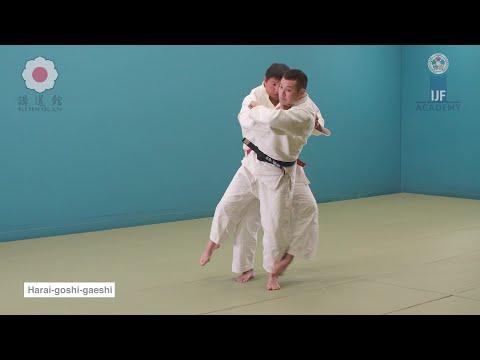
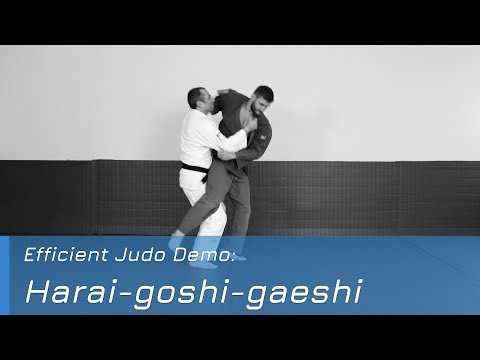

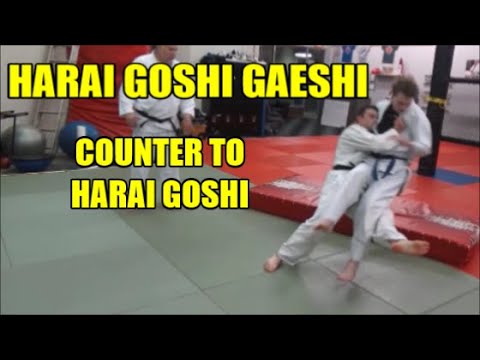
Harai-Goshi-Gaeshi — Step by Step
Kuzushi is supplied by uke's own forward rotational drive into the Harai-Goshi entry. As uke turns across tori's front, their body weight and momentum are directed forward and rotationally — tori exploits this by wrapping and redirecting that momentum backward into the counter-throw. The force uke generates for the original throw becomes the force that topples them.
As uke rotates into the Harai-Goshi hip entry, step your outside foot (right foot if uke enters right) around to uke's outside-rear, bypassing uke's entry. Simultaneously wrap your arm around uke's waist or grip uke's hip. Your chest comes against uke's back or side. Your hips press into uke's lower back as you position for the backward arch.
Arch backward sharply, driving your hips into uke's lower back while pulling uke's upper body forward and over. Uke's rotational momentum carries them over your hip in a backward arc. Direct the fall so uke lands on their back to tori's rear.
- 1
Read uke's Harai-Goshi entry
Recognize the grip pull and hip rotation that signal a Harai-Goshi attempt. The moment uke begins to turn their back and extend the sweeping leg, the counter window opens.
- 2
Step to uke's outside to bypass the hip entry
Step your foot to the outside of uke's entry — to the side not being swept — so you move around uke's attack rather than into it. This positions you behind or to the side of uke's center.
- 3
Wrap the waist and press your hip into uke's back
As you step around, wrap your arm around uke's waist and pull your hips into uke's lower back or hip. Your body now loads against uke's rear-center.
- 4
Arch backward to load the counter throw
Drive your hips backward into uke's lower back while arching your upper body away. This creates a hip fulcrum that lifts uke's feet off the mat and redirects their forward rotation backward.
- 5
Pull uke's upper body forward and over
Pull uke's arm and torso forward (in the direction they were already rotating) as you arch backward. Uke's body folds over your hip and falls to the mat behind you.
What Makes It Work
- The counter leverages uke's rotational commitment — the more aggressively uke enters Harai-Goshi, the stronger the counter.
- Stepping to the outside rather than resisting in front is the key positional move. Trying to block Harai-Goshi from in front is far less effective.
- The hip arch backward is the throwing mechanism — press the hips into uke's lower back and arch away to create the backward lift over the hip.
- Uke's forward rotational direction during the Harai-Goshi entry is preserved in the counter — they continue rotating, but now backward over tori's hip.
- Timing must be at the entry phase. If uke has already completed the sweep and established position, the counter is more difficult.
What to Avoid
Trying to resist the Harai-Goshi frontally instead of stepping outside
Move to uke's outside rather than blocking. Frontal resistance allows uke to adjust their hip position or add more force.
Stepping inside uke's attack instead of outside
Ensure you step to the outside (away from the sweeping leg). Stepping to the inside places you in the path of the original throw.
No hip contact — counter throw becomes an arm throw only
Your hip must press into uke's lower back to create the fulcrum. Without hip contact, the backward arch has no lever.
Counter throw too late — uke has completed Harai-Goshi and released
The counter must be initiated during uke's entry. After uke has swept through and released the throw, the moment is past.
Best Moments to Apply Harai-Goshi-Gaeshi
Harai-Goshi-Gaeshi is most effective against opponents who drive aggressively and repeatedly with Harai-Goshi. The heavier uke's hip rotation, the more power is available for the counter. It can also apply against Hane-Goshi and similar hip-sweep entries where uke rotates across tori's front. A player who establishes this counter forces opponents to slow or modify their Harai-Goshi attack.