Quick Facts
- Category
- Katame-Waza
- Subcategory
- Kansetsu-Waza
- Difficulty
- Advanced
- Belt Level
- 1st kyu, 1st dan
Hara-Gatame is an armlock in which tori traps uke's arm across tori's own abdomen or hip and uses their body weight to hyperextend uke's elbow joint — with tori's stomach/hip acting as the fulcrum rather than the hip as in Juji-Gatame. Applied from north-south position (tori straddles uke's torso or sits on uke's chest facing uke's feet), tori captures one of uke's arms across their own midsection, controls the wrist, and leans or sinks their body weight to drive the elbow into extension. It is part of the official Kodokan kansetsu-waza (joint technique) classification.
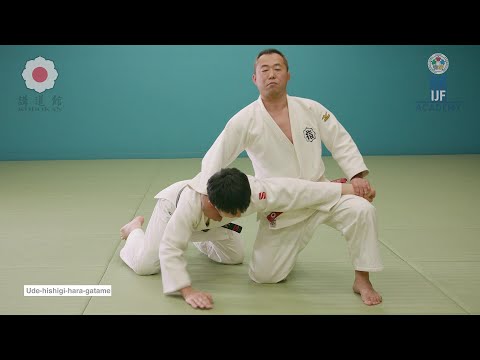
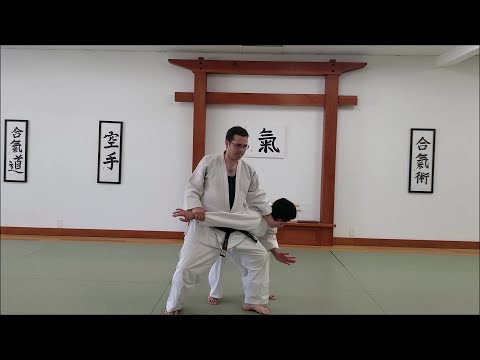
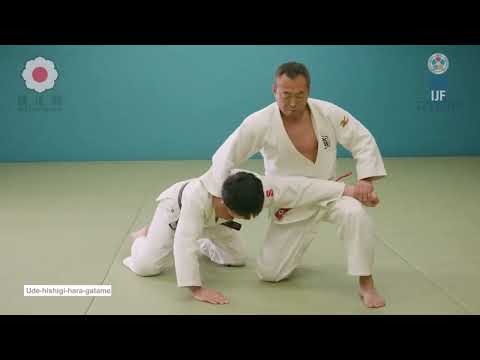
Hara-Gatame — Step by Step
- 1
Establish north-south or straddle position on uke's chest
Position yourself facing uke's feet while sitting on or straddling their chest area. This north-south orientation gives you access to both of uke's arms from above.
- 2
Capture uke's target arm and extend it
Trap one of uke's arms — pulling it upward and straightening it. The arm should be extended, with the elbow straight. Grip near uke's wrist with both hands or one hand and your arm.
- 3
Position uke's elbow against your abdomen
Pull uke's extended arm across your stomach and hip area so that the back of uke's elbow rests against your lower abdomen or hip. Your stomach is now the fulcrum for the extension.
- 4
Secure the wrist and control the arm direction
Hold uke's wrist firmly with both hands and control the direction of the arm — the wrist should be directed downward (toward the mat) while the elbow presses against your abdomen.
- 5
Apply body weight to hyperextend the elbow
Lean forward or sink your body weight downward through your abdomen into uke's elbow, while simultaneously pulling the wrist downward. The opposing forces — weight down on elbow, wrist pulled down past the fulcrum — hyperextend the joint. Apply progressively, releasing immediately when uke taps.
What Makes It Work
- The fulcrum is your own abdomen or hip — this distinguishes Hara-Gatame from Juji-Gatame (hip/thigh fulcrum) and Ude-Gatame (wrist fulcrum).
- The arm must be fully extended before pressure is applied. Any bend at the elbow significantly reduces effectiveness and can cause the lock to slip.
- Body weight is the primary force — leaning into the elbow via the stomach, not pulling with arms alone. Tori's mass drives the hyperextension.
- The wrist must be directed downward (toward the mat surface) opposite to the upward pressure at the elbow — this creates the opposing force couple that breaks the joint.
- North-south position is the most stable application point, giving tori full body-weight access while uke has limited bridging or rolling escape options.
- Apply Hara-Gatame with progressive pressure only — the elbow joint under this angle reaches the hyperextension limit quickly.
What to Avoid
Elbow not against the abdomen — fulcrum is missing
Pull uke's arm tight across your midsection until the elbow is in contact with your lower abdomen. Without the fulcrum contact, the extension force has no pivot point.
Arm still bent at the elbow when applying pressure
Straighten uke's arm completely before applying body weight. A bent arm absorbs the pressure without reaching hyperextension until it is straightened.
Using only arm strength to pull the wrist down without body weight
Lean your body forward or sink downward through the abdomen. The shoulder and body weight greatly exceed the force available from arms alone.
Applying too rapidly — risk of elbow injury
Hara-Gatame reaches the hyperextension limit quickly. Apply slowly and with progressive force, giving uke sufficient time to tap. Rapid application is a significant injury risk.
Unstable north-south position — uke bridges and escapes
Sit firmly on uke's chest and maintain base with your legs on both sides. An unstable position allows uke to bridge and roll, breaking the arm contact.
Best Moments to Apply Hara-Gatame
Hara-Gatame is most applicable when tori is in north-south position and uke has an arm trapped at chest level. It can also be applied as a transition when Juji-Gatame entry is blocked — if uke fights the standard perpendicular positioning, shifting to north-south and applying Hara-Gatame can catch uke off guard. In competition, it is a useful secondary armlock when the primary Juji-Gatame position is not available. Also applicable when uke reaches up from bottom position and over-extends an arm toward tori.