
Quick Facts
- Category
- Nage-Waza
- Subcategory
- Yoko-Sutemi-Waza
- Difficulty
- Intermediate
- Belt Level
- 3rd kyu, 2nd kyu
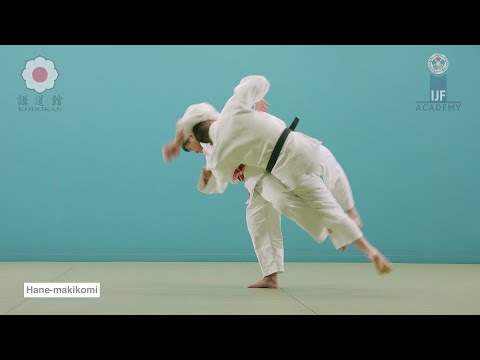
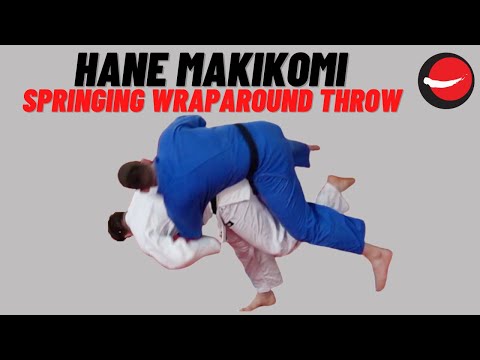
Hane-Makikomi is the makikomi variant of Hane-Goshi — combining the springing knee action with an arm wrap and side fall sacrifice. Tori enters for Hane-Goshi but wraps uke's arm and falls to the side, creating a more committed throw. The spring of the knee combined with the sacrifice makes this a particularly powerful technique that is difficult to defend once the arm is wrapped.

Hane-Makikomi — Step by Step
Pull uke forward and upward — identical to Hane-Goshi kuzushi. The sleeve arm elevates and pulls uke forward. Uke's weight loads to their front. The arm wrap begins during the entry to set up the makikomi element.
Step in as for Hane-Goshi — right foot in front of uke, pivot to back-facing. Simultaneously wrap the entry arm around uke's arm. Bend both knees on entry, coiling the spring leg for the kake.
Spring the right knee upward into uke's thigh while simultaneously maintaining the arm wrap and falling to the side. The three elements — spring, wrap, fall — converge simultaneously. Uke is thrown in a powerful arc with the spring launching them and the sacrifice ensuring follow-through.
- 1
Create forward kuzushi
Pull uke forward and upward onto their front corner.
- 2
Step in and pivot
Step in, pivot back-to-chest, begin arm wrap.
- 3
Wrap the arm
Trap uke's arm against your chest as you complete the pivot.
- 4
Coil the spring leg
Bend the right knee deeply — coiling for the spring action.
- 5
Spring, wrap, and fall
Simultaneously: spring the knee up into uke's thigh, maintain the arm wrap, and fall to the side. Uke is thrown powerfully.
What Makes It Work
- The spring must be genuine — bend the knee deeply and drive upward with force. The spring amplifies the sacrifice throw significantly.
- All three elements must occur simultaneously: spring, arm wrap, side fall.
- Hane-Makikomi is a high-commitment throw — once entered, follow through completely.
- Ensure uke has good ukemi before drilling at speed, as the arm wrap limits their defensive breakfall.
What to Avoid
Insufficient knee bend before the spring
Coil the knee deeply on entry. A shallow bend produces a weak spring with minimal lift effect.
Spring then fall — sequential rather than simultaneous
All three elements converge at the same moment. Practice the coordination in slow drills before adding speed.
Loose arm wrap
Pull uke's arm firmly to your chest. Loose wrap lets uke post and defend.
Falling to the wrong side
Fall to the side corresponding to the spring leg. Falling to the wrong side negates the spring direction.
Best Moments to Apply Hane-Makikomi
Hane-Makikomi is used when Hane-Goshi defenses are anticipated, or as a committed entry when uke's arm position can be wrapped. Practitioners who use Hane-Goshi as their main throw often develop this variant to counter the common defenses.