
Quick Facts
- Category
- Nage-Waza
- Subcategory
- Koshi-Waza
- Difficulty
- Intermediate
- Belt Level
- 4th kyu, 3rd kyu
Hane-Goshi is a dynamic hip throw that adds a spring or bounce action to the hip entry. Unlike Harai-Goshi where the leg sweeps, in Hane-Goshi tori bends the knee and "springs" (hane) it into uke's thigh in an upward, springing motion while simultaneously loading uke over the hip. The spring action creates a powerful launching effect, projecting uke high and far.
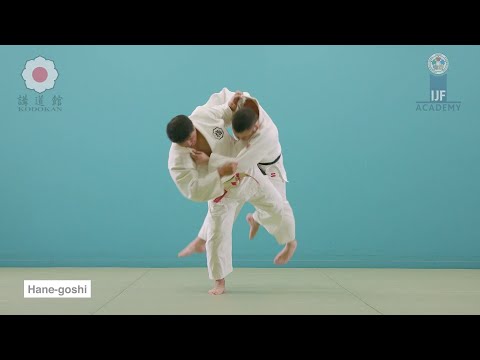
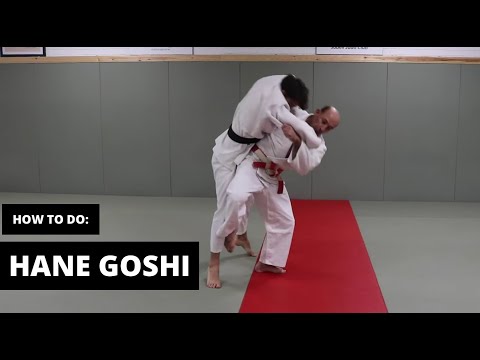
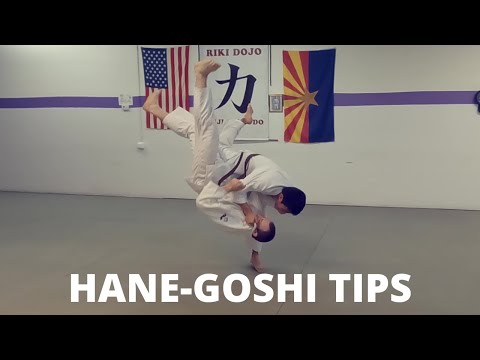

Hane-Goshi — Step by Step
Pull uke forward and upward onto their right front corner with the sleeve grip. The lapel arm simultaneously pulls uke's chest forward. Uke must be on their toes with weight fully forward. The higher and more forward the kuzushi, the more effective the spring action of the knee will be.
Step the right foot in front of uke and pivot so your back faces uke's chest, similar to a standard hip throw entry. Bend both knees as you enter. Your right knee bends deeply — preparing to spring. Keep your back tight to uke's chest. The sleeve and lapel grips maintain upward tension.
Extend both legs explosively — the right bent knee drives upward and springs into uke's inner thigh or the back of their right thigh. This springing knee action lifts uke off the ground and combines with the rotation of your upper body and arm pulls to project uke in a high, powerful arc over your right hip.
- 1
Create forward-upward kuzushi
Pull sleeve arm upward and forward. Lapel arm pulls chest forward. Uke rises to their toes with weight loading forward.
- 2
Step in and pivot
Step right foot in front of uke and pivot back-to-chest. Bend both knees deeply on entry.
- 3
Load the springing knee
Bend the right knee deeply, bringing the heel up toward the back of the thigh. This coils the spring for the kake.
- 4
Drive the knee upward into uke's thigh
Spring the right knee upward into uke's inner thigh. The knee drives upward and forward — not a sweep, but a spring or bounce.
- 5
Complete the throw with rotation and arm pull
Simultaneously rotate forward at the hip, pull both arms forward and downward. Uke is launched over the hip in a high arc.
What Makes It Work
- The spring (hane) action is the distinctive feature — the knee bends and then explodes upward. This is different from the sweeping action of Harai-Goshi.
- The springing knee creates vertical lift. Uke is launched upward and over, not just swept forward.
- Both knees must bend on entry. The standing leg bends to lower the hip; the springing leg coils for the drive.
- Timing the spring to uke's loaded forward position is essential. The spring amplifies the force already created by kuzushi.
What to Avoid
Sweeping the leg instead of springing
Hane-Goshi uses a bent-knee spring, not a sweeping extension. The knee bends deeply and then drives upward — think spring, not sweep.
Insufficient knee bend before the spring
The knee must coil deeply before the spring. A shallow bend produces a weak spring with minimal lifting force.
Springing without forward rotation
The spring amplifies rotation — it does not replace it. Rotate your upper body forward simultaneously with the spring for maximum throw power.
Hip too high — not below uke's hip
Bend the knees on entry to lower your hip below uke's. A high hip blocks the loading and reduces the effectiveness of the spring.
Best Moments to Apply Hane-Goshi
Hane-Goshi is effective against opponents who defend standard hip throws by spreading their legs or lowering their hips. The spring action bypasses low defenses by adding vertical lift. It is also effective against opponents with good forward kuzushi sensitivity — the explosive spring provides force before they can react.
Variations of Hane-Goshi
Combination Sequences
Follow up with