Quick Facts
- Category
- Katame-Waza
- Subcategory
- Shime-Waza
- Difficulty
- Intermediate
- Belt Level
- 3rd kyu, 2nd kyu
Hadaka-Jime is applied without using the judogi — tori's forearm wraps directly around uke's neck. Known widely as the "rear naked choke" in MMA and submission grappling, it is highly effective because it does not depend on gripping the jacket. Applied from behind, the forearm compresses the carotid arteries. It is the most widely recognized submission hold in all combat sports.
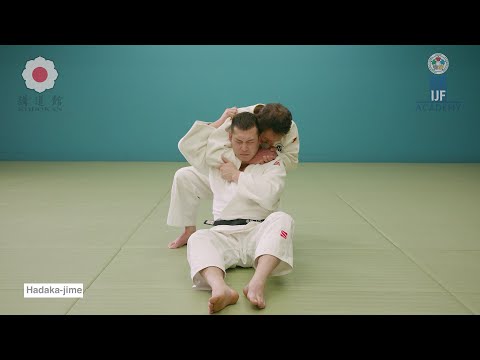
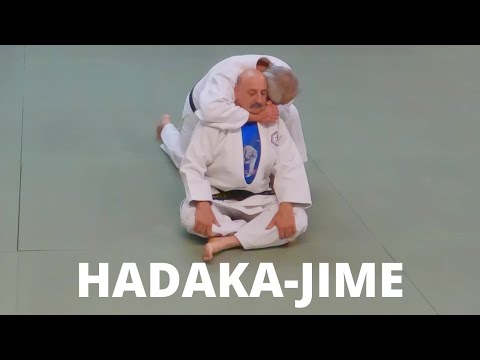
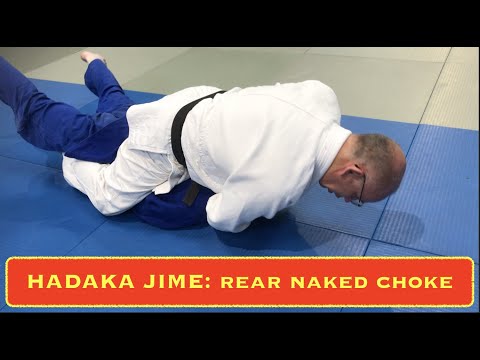
Hadaka-Jime — Step by Step
- 1
Establish back control
Get behind uke with your chest against their back. Hook your legs around uke's hips to maintain the position.
- 2
Slide your right arm across uke's throat
Wrap your right arm around uke's neck so the crook of your elbow aligns with the center of their throat. Your forearm slides across to their right carotid.
- 3
Place your left hand behind your right bicep
Reach your left hand over uke's left shoulder and grip your own right bicep to form the figure-four: your right arm is across the throat, your left hand squeezes the right bicep, and your right hand rests on your own left shoulder or the back of uke's head.
- 4
Place your left hand behind uke's head
Push uke's head forward with your left hand. This tightens the choke by removing their ability to pull their chin down.
- 5
Squeeze both arms and arch back
Squeeze your arms together to compress both carotids. Arch your back to intensify the pressure. Both elements together create rapid carotid compression.
What Makes It Work
- The crook of the elbow should be at the center of the throat (adam's apple area), not the forearm across the throat.
- The figure-four grip (hand on bicep) amplifies pressure significantly over a simple wrist grip.
- Pushing the head forward with the rear hand removes uke's ability to tuck their chin, which is the primary defense.
- Arching away from uke stretches the neck and tightens the grip simultaneously.
What to Avoid
Forearm across the throat (windpipe) instead of carotid
The crook of the elbow — not the forearm — sits at the throat. The forearm and upper arm compress the carotids on both sides.
Not using the figure-four grip
Grip your bicep, not your wrist. The figure-four creates far more mechanical pressure.
Allowing uke to tuck their chin
Push their head forward with your rear hand to prevent chin tuck. Once uke tucks the chin, the choke is partially blocked.
Best Moments to Apply Hadaka-Jime
Hadaka-Jime is the primary option whenever you have back control. If uke's collar is accessible, Okuri-Eri-Jime is an equally strong choice — both should be drilled as co-primary options from the back position. Extremely effective when uke is turtled and you have hooks in, or when no gi collar is available.