Quick Facts
- Category
- Katame-Waza
- Subcategory
- Shime-Waza
- Difficulty
- Intermediate
- Belt Level
- 3rd kyu
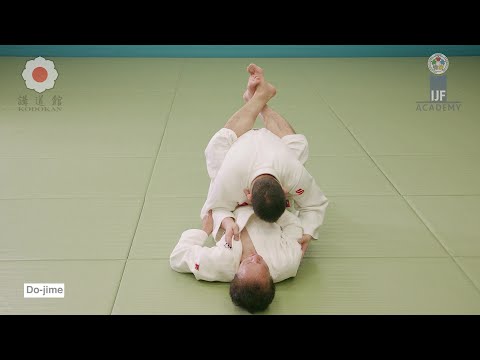
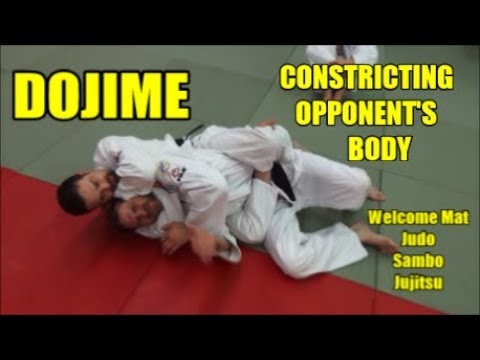
Do-Jime is a scissors-hold in which tori wraps both legs around uke's torso (trunk/waist area) and squeezes with the thighs to compress the rib cage and diaphragm. IMPORTANT: Do-Jime is permanently banned in IJF sanctioned competition due to the risk of severe spinal injury — the compressive and twisting force of leg scissors around the torso can cause lumbar vertebra damage or internal organ injury. Despite the competition ban, Do-Jime remains part of the official Kodokan shime-waza classification and appears in traditional kata (particularly Katame no Kata) and formal curricula study. It is listed here for historical and technical completeness.

Do-Jime — Step by Step
Do-Jime is a ne-waza technique; the traditional kuzushi–tsukuri–kake framework for standing throws does not directly apply. Positional control is established by securing body contact around uke's trunk — typically from guard position or while controlling uke's upper body — before the legs are wrapped and locked around the torso.
From a supine or guard position, wrap both legs around uke's torso at the waist or lower rib cage. The ankles may cross behind uke's back or hook together. Your legs are positioned above uke's hips to compress the trunk, not the pelvis. Body contact is maintained throughout.
Squeeze both thighs inward to compress uke's rib cage and restrict diaphragm movement. The compression force is directed inward from both sides simultaneously. In the traditional form, sustained squeezing forces uke to submit from respiratory restriction or discomfort.
- 1
Establish guard position around uke's torso
From your back with uke inside your legs, position your legs around uke's torso at the lower rib cage level — above the hips and below the armpits.
- 2
Cross or hook ankles behind uke's back
Cross your ankles together or hook them to lock the leg wrap in position. The locked leg position is what generates and sustains the squeeze pressure.
- 3
Squeeze the thighs together to compress the trunk
Drive both thighs inward, compressing uke's rib cage from both sides simultaneously. The squeeze should be steady and increasing — not a single burst of force.
- 4
Maintain upper body control
Control uke's posture with your arms throughout — gripping the collar, sleeves, or neck area to prevent uke from posturing up and breaking the leg wrap.
What Makes It Work
- SAFETY WARNING: Do-Jime is banned in IJF competition (permanently). It is studied only in kata and traditional contexts. Never apply Do-Jime in randori or competition settings.
- The technique compresses the rib cage and restricts breathing — it operates by respiratory restriction rather than carotid artery compression.
- Leg positioning is above the hips (at the lower ribs), not at the pelvis. Pelvis-level scissors (do-jime applied at the hip joint) carries a higher spinal injury risk.
- The IJF ban reflects the spinal injury risk when a powerful leg scissors applies rotational and compressive force to the lumbar spine simultaneously.
- In Katame no Kata, Do-Jime is studied formally as part of the shime-waza section, demonstrating its technical legitimacy within classical judo.
What to Avoid
Applying Do-Jime in IJF competition or standard randori
Do-Jime is banned in competition and not appropriate for normal randori. Study it only in kata contexts under direct supervision.
Leg position at the pelvis level rather than the lower ribs
The legs should encircle the torso above the hips, at the lower rib cage. Pelvis-level scissors creates a dangerous twisting force on the lumbar spine.
Applying explosive bursts of force rather than steady compression
In kata practice, apply Do-Jime with slow, controlled increasing pressure. Explosive force is particularly dangerous to the ribs and spine.
Best Moments to Apply Do-Jime
Do-Jime is studied exclusively in traditional kata contexts (Katame no Kata) and classical curriculum. It has no application in modern competition. Understanding it provides completeness in the Kodokan shime-waza classification and context for why the IJF introduced the prohibition.