
Quick Facts
- Category
- Nage-Waza
- Subcategory
- Yoko-Sutemi-Waza
- Difficulty
- Advanced
- Belt Level
- 1st kyu, 1st dan
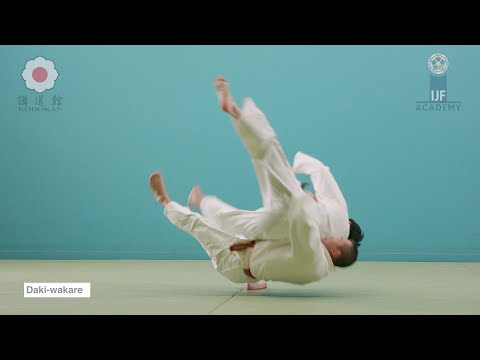
Daki-Wakare is an advanced side sacrifice throw where tori wraps around uke from behind, lifts them, and falls to the side — separating uke and depositing them on the mat with a high-lift motion. The "daki" (embracing) refers to the rear bear-hug wrap, and "wakare" (separation) refers to the separation of the bodies as uke is thrown. It requires considerable strength and timing.


Daki-Wakare — Step by Step
Tori approaches uke from behind or works around to the rear, wrapping both arms around uke's torso. The lift itself provides the kuzushi — uke is picked up and their feet leave the ground, completely removing their base.
Wrap both arms around uke's torso from behind — ideally below the arms and around the midsection. The grip may clasp at the front of uke's torso, or grip the belt. Position your hips behind and below uke's hips to provide lift leverage.
Lift uke off the ground with a powerful drive from the legs and hips. Once lifted, fall to the side — the sacrifice. As you fall sideways with uke in your arms, the momentum separates uke and carries them over to land on the mat.
- 1
Get behind uke or maneuver to the rear
Position yourself behind uke — typically from a gripping exchange or after a failed throw attempt by uke.
- 2
Wrap both arms around the torso
Secure a deep two-arm rear wrap around uke's midsection. The grip must be secure — hands clasped or belt grip.
- 3
Position for the lift
Bend your knees and position your hips behind and below uke's hips for the upward lift drive.
- 4
Lift uke high
Drive upward with the legs, lifting uke clear of the ground. The higher the lift, the more effective the subsequent fall.
- 5
Fall to the side and separate
Fall decisively to the side while pulling uke over. As you land, the bodies separate (wakare) and uke is deposited on the mat.
What Makes It Work
- Getting behind uke is the prerequisite — Daki-Wakare is impossible from the front or side without a complete repositioning.
- The lift must be high and driven from the legs, not just the arms. Leg drive provides the power for the lift.
- The side fall must be committed and complete. Hesitating creates a muddled position.
- Daki-Wakare requires physical strength and is considered one of the more athletic techniques in judo.
What to Avoid
Wrapping around the chest (too high)
The wrap should be around the midsection or below the arms. A chest-level wrap reduces lift power and may injure uke's ribs.
Falling backward instead of to the side
Daki-Wakare is a yoko-sutemi (side sacrifice). Fall to the side, not straight backward — that would be a different technique.
Insufficient lift before the fall
Lift uke before falling. Falling while uke is still grounded results in a tangled mess, not a throw.
Losing the grip during the fall
Maintain the rear wrap until the momentum has carried uke away. Early release may drop uke on top of you.
Best Moments to Apply Daki-Wakare
Daki-Wakare is used when tori manages to get behind uke — in a grip fight, after a failed throw, or in newaza transitions. It is also used as a counter when uke's forward attack exposes their back. As an advanced technique it requires extensive practice before competition use.