
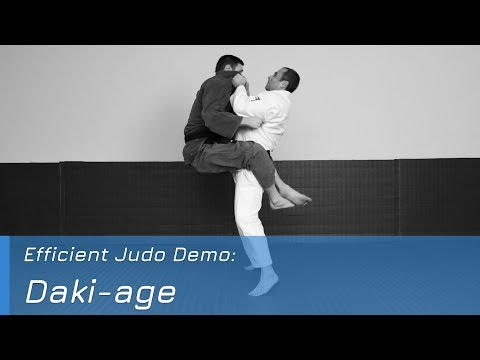
Daki-Age is a powerful lifting throw in which tori wraps both arms around uke's torso — either from behind in a bear-hug position or from the front — lifts uke completely off the ground, and drops them backward or to the side. The technique requires exceptional physical strength and a large size or weight advantage. IMPORTANT: Daki-Age has been banned in IJF sanctioned competition since 2010 due to the severe risk of spinal injury — lifting uke inverted and dropping them risks catastrophic cervical or lumbar spine damage. Despite the competition ban, it remains part of the official Kodokan Shinmeisho no Waza classification and is studied in traditional kata contexts.

Daki-Age — Step by Step
Kuzushi is created by wrapping both arms tightly around uke's torso and squeezing, compressing uke's body and lifting their centre of gravity upward off the ground. Once uke is fully airborne, they have no base from which to resist — the kuzushi is absolute but requires complete lift to achieve.
Enter close behind or in front of uke, wrapping both arms around their body at the waist or lower torso. For the rear version, your chest presses into uke's back. Bend your knees to get under uke's centre of gravity. Your arms lock tight in a bear-hug grip (wrists clasped or interlocked hands).
Drive upward through your legs to lift uke entirely off the ground. Once airborne, lean backward or twist to one side, directing uke's fall to the mat — onto their back or side. The completion is uke landing with tori controlling the descent direction.
- 1
Establish the bear-hug grip from behind or front
Wrap both arms firmly around uke's torso at the waist level. Clasp your hands together or interlace your fingers for a secure lock. This grip is the sole mechanism of the throw — it must be tight and low enough to get under uke's center of mass.
- 2
Bend your knees and sink under uke's center
Drop your hips by bending your knees so your center of gravity is below uke's hips. This creates the leverage for the lift — you are pressing up from below uke's waist.
- 3
Drive through the legs to achieve full lift
Push explosively through both legs to straighten the knees and raise uke off the mat entirely. The lift must be complete — uke's feet must clear the ground for the throw to function.
- 4
Lean backward or twist and direct the fall
Once uke is airborne, lean backward (for the rear version) or twist to the side, using your body direction to guide where uke lands. Control the descent to avoid dropping uke vertically on their head.
- 5
Land in a position of control
Ensure uke lands on their back or side, not on their head or neck. Release or soften the grip before full impact to reduce injury risk.
What Makes It Work
- WARNING: Daki-Age is banned in IJF competition (since 2010) due to the risk of spinal injury from dropped lifts. Study this technique only in a kata or historical context under qualified supervision.
- The lift requires complete elevation of uke off the mat — a partial lift still leaves uke with ground contact and resistance.
- Getting your hips below uke's center of mass is the mechanical requirement — the legs drive the lift, not the back.
- The throw is only as effective as the arm wrap is tight — any gap allows uke to twist free or brace against a surface.
- In the traditional context, Daki-Age demonstrated the ability to nullify any technique by lifting uke out of position entirely.
What to Avoid
Attempting Daki-Age in IJF competition
This technique is prohibited in IJF and most major federation competitions since 2010. Attempting it results in disqualification and risks serious injury to your partner.
Failing to get hips below uke's center before lifting
Bend the knees deeply before lifting. If your hips are at the same level as uke's, you will strain your lower back rather than drive through the legs.
Loose arm grip — uke escapes or twists
Clasp your hands as tightly as possible and keep your elbows pulled in. A loose bear hug allows uke to rotate their torso and break free.
Dropping uke vertically on their head
Always direct the fall backward or to the side. A vertical drop is dangerous and constitutes a competition foul (hansoku-make) even in situations where the lift is permitted.
Best Moments to Apply Daki-Age
In traditional and kata contexts, Daki-Age is studied as a technique against an opponent who is extremely defensively crouched or has secured an unbreakable grip. It represents the ultimate removal of an opponent from the ground. In modern competition it is not applicable due to the ban. In randori, it may be explored cautiously with size-matched partners under direct instructor supervision.