
Quick Facts
- Category
- Katame-Waza
- Subcategory
- Kansetsu-Waza
- Difficulty
- Advanced
- Belt Level
- 1st kyu, 1st dan
Ashi-Garami is a leg entanglement technique that locks uke's knee joint by entwining the leg with tori's legs and applying bending force against the natural direction of the knee. It is a recognized Kodokan technique but is illegal in IJF international competition due to the risk of catastrophic knee injury. It remains legal in some other competition rulesets and is studied as part of the complete Kodokan curriculum.
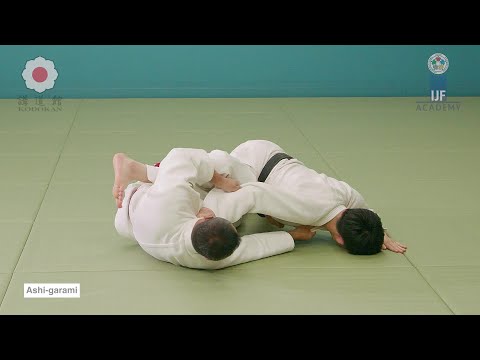
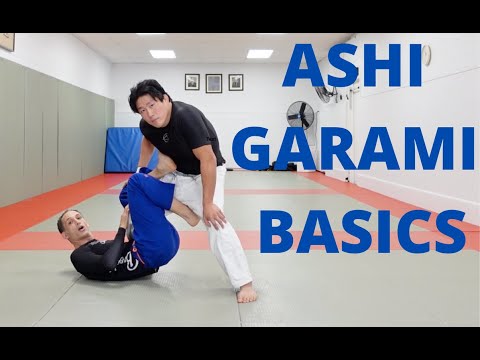
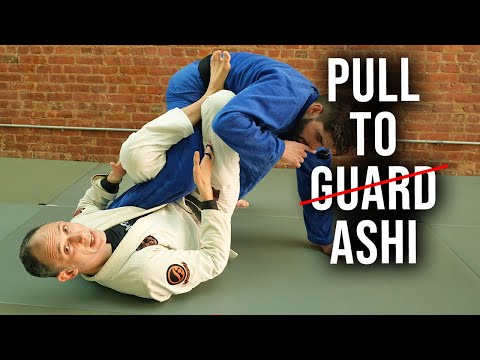
Ashi-Garami — Step by Step
- 1
Control uke's leg
Gain control of one of uke's legs — typically the near leg — from a ground position.
- 2
Entangle the leg with tori's legs
Wrap your legs around uke's leg to create the entanglement. One leg hooks over the top of uke's leg, the other may hook under for the lock.
- 3
Secure the leg position
Tighten the entanglement so uke cannot pull the leg free. The entire lower limb is trapped.
- 4
Apply force to the knee joint
With the leg entangled, use your body mechanics — rotation, hip drive — to apply bending or twisting force to uke's knee against its natural direction.
- 5
Apply pressure until submission
Apply consistent pressure. This is an extremely dangerous technique — practice only with experienced partners and tap early.
What Makes It Work
- IMPORTANT: Ashi-Garami is illegal in IJF international competition. Do not use in IJF-rules competition.
- The knee joint is extremely vulnerable to this technique. Both partners must exercise extreme caution — the knee can be damaged quickly.
- Ashi-Garami is a Kodokan-recognized technique studied for complete judo knowledge, not for competition application under IJF rules.
- From the Ashi-Garami entanglement, other transitions are possible — understanding the position matters even if the straight leg lock is illegal in some contexts.
What to Avoid
Applying in IJF competition
Never apply Ashi-Garami in IJF competition — it is banned and will result in disqualification.
Applying too quickly without partner awareness
This technique must be drilled slowly and with complete partner cooperation. The knee can be injured before the partner can tap. Always warm up the joint and drill at a controlled pace.
Not tapping immediately when feeling pressure
If you are in Ashi-Garami as uke, tap as soon as you feel joint pressure. Waiting to feel pain risks serious injury.
Loose leg entanglement — uke escapes easily
The entanglement must be tight to prevent the leg from being pulled free. Tighten the leg wrap before applying pressure.
Best Moments to Apply Ashi-Garami
Ashi-Garami is studied as part of the Kodokan syllabus for comprehensive judo knowledge. It is applicable in non-IJF competition contexts where leg attacks are permitted. In IJF competition, Ashi-Garami is explicitly prohibited. Practitioners should be aware of the competition rules governing their events before considering any leg-lock application.